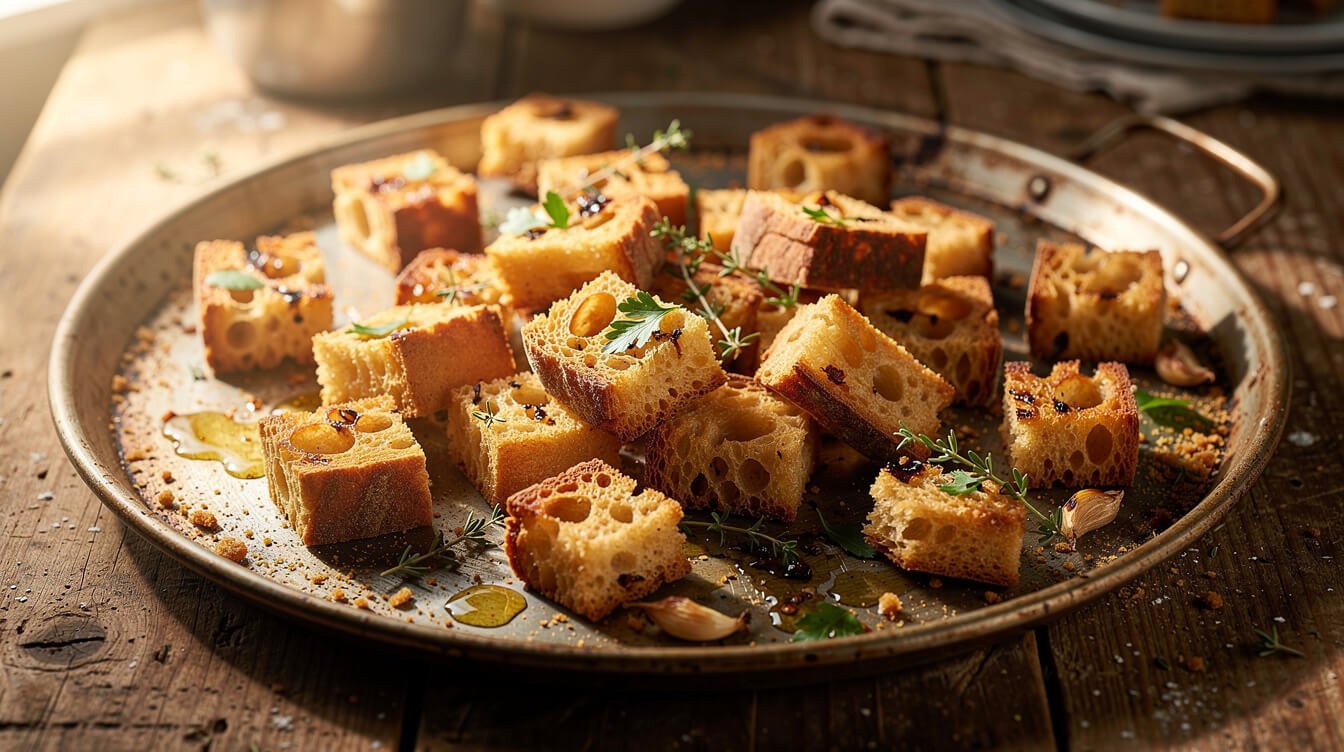
How to make croutons from sourdough bread (the recipe changes with how stale your loaf is)
You have most of a sourdough loaf on the counter and it is past its best. Learning how to make croutons from sourdough bread is the obvious answer, and every recipe you find will tell you the same thing: cube it, oil it, bake it. Then you do that, and half the tray comes out scorched, a few pieces stay chewy in the middle, and the ones you saved for soup turn to mush in about ninety seconds.
Here is what those recipes leave out. Your loaf has a specific age, and that age decides three things: how big you cut the pieces, how much oil they need, and how long they stay in the oven. A springy day-old loaf and a rock-hard four-day-old heel are not the same ingredient, and treating them the same is why crouton trays come out uneven.
So squeeze the loaf first. Then pick your numbers from the chart below, and I will walk you through the base recipe, the fix for sourdough’s big-hole crumb, and how to keep them crunchy once they hit soup.
Squeeze the loaf first — day-old, stale, or rock-hard changes everything
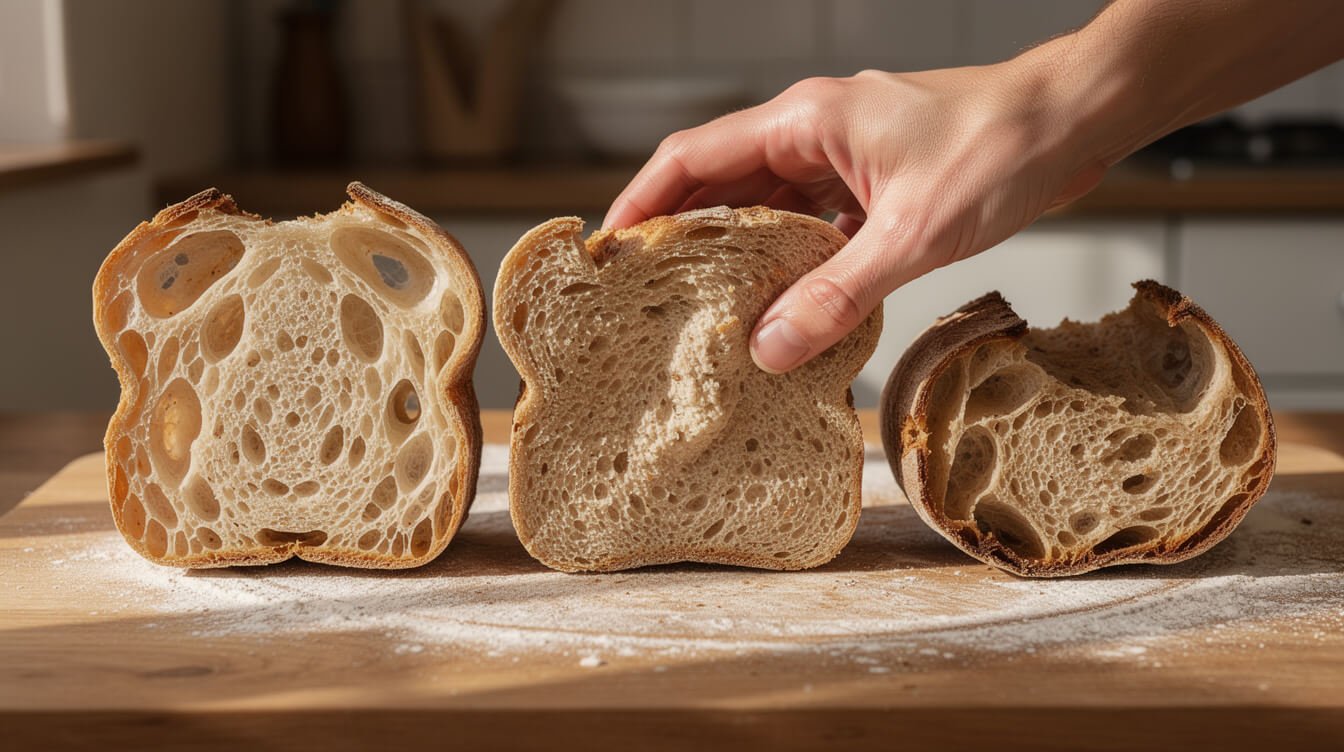
Press your thumb into the middle of a slice. What happens next tells you which recipe you are running.
Day-old and springy. The crumb gives under your thumb and mostly bounces back. There is still real moisture in there. It will shrink noticeably as it dries in the oven, so cut bigger, use less oil, and give it more time at a lower heat.
Properly stale, two to four days. It compresses a little and stays compressed. Dry to the touch, still sliceable with a bread knife. This is the sweet spot — it is already halfway to being a crouton, it drinks oil instead of sitting in it, and it barely shrinks.
Rock-hard, five days or more. Your thumb does nothing. The knife skates. Do not try to cube this; see the tearing section below.
Here is the whole thing in one table. Quantities are per 8 ounces (about 225 g) of bread, which is roughly half a standard boule and gives you 4 to 5 cups of croutons.
| Loaf state | Cut size | Oil | Oven |
|---|---|---|---|
| Day-old, springy | 1-inch cubes | 2 tbsp | 350°F, 22–28 min |
| Stale, 2–4 days | 3/4-inch cubes | 3 tbsp | 350°F, 18–22 min |
| Rock-hard, 5+ days | Torn chunks | 3–4 tbsp | 325°F, 25–30 min |
One thing to check before any of this: look the loaf over for mold. If you find any — a fuzzy spot, a green or black patch, even a small one — throw the whole loaf out. Bread is porous, and mold sends threads deeper than the part you can see, so cutting around a moldy patch on a soft loaf is not enough. Hard and dry is fine to cook with. Fuzzy is not.
How to make croutons from sourdough bread: the base recipe
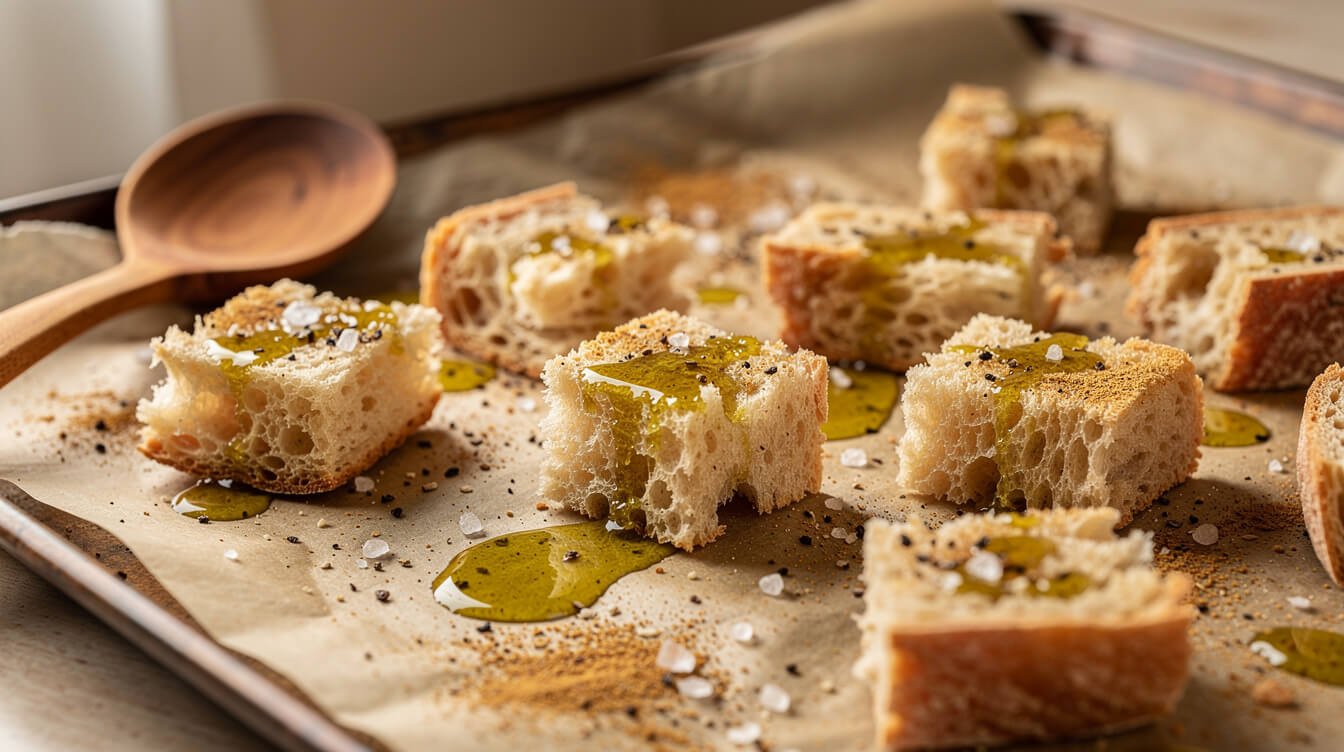
This is the day-old version, the one most people are actually holding. Adjust with the table above if your loaf is older.
What you need
- 8 oz (225 g) day-old sourdough bread, about half a boule
- 2 tbsp (30 ml) olive oil
- 1/2 tsp fine salt
- 1/4 tsp freshly ground black pepper
- 1/2 tsp garlic powder (optional, and better than fresh garlic here — see the seasoning section)
What you do
- Heat the oven to 350°F (175°C). Pull out a rimmed sheet pan. Parchment makes cleanup easier but is not required.
- Slice the loaf about an inch thick, then cut the slices into roughly 1-inch cubes. Leave the crust on. Perfectly even cubes are not the goal; roughly even thickness is.
- Put the cubes in a big bowl. Drizzle the oil over them in a thin stream while tossing with your other hand, so it lands on many pieces instead of soaking two. Add the salt, pepper, and garlic powder and toss again.
- Spread them on the pan in a single layer with space between pieces. Crowding steams them. Use two pans if you need to — this is the difference between crisp and leathery.
- Bake 22 to 28 minutes, tossing at the 12-minute mark and again at 20. They are done when they are deep golden at the edges and sound hollow and hard when you tap one on the pan.
- Take one out, let it cool for a full minute, and bite it. It should crack, not bend. Croutons firm up considerably as they cool, so if it is crisp outside and barely soft at the center, that is right. If the middle is still bready, give it 4 more minutes.
That cooling test is the only doneness check that matters, and it is the one most recipes skip. A crouton straight off a hot pan always feels softer than it will be in five minutes.
Do not have a loaf to work with yet? Our guide to making a sourdough starter from scratch is the place to begin, and the flour you choose has more to do with your crumb than almost anything else.
Rock-hard loaf? Tear it, don’t cube it
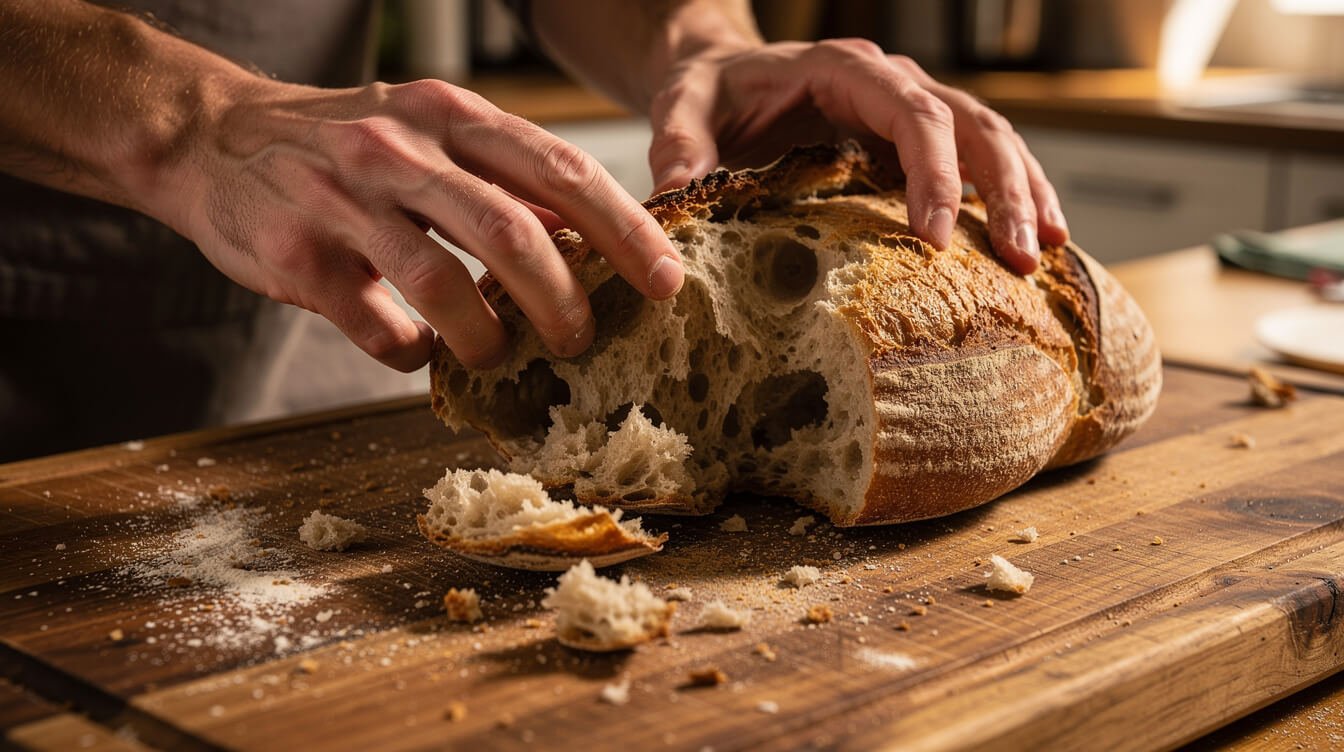
Nobody warns you about this, and it is the point where people get hurt. A five-day-old sourdough heel is genuinely hard, and a knife pressed into a hard round loaf does not cut — it slides. Your other hand is right there. Every year people take a trip to urgent care over stale bread.
So stop cutting and start tearing. Work your thumbs into a cut edge and pull the loaf apart into rough chunks somewhere between a grape and a walnut. Craggy is good: the torn faces have far more surface area than a clean-cut cube, which means more browned edges and more crunch per piece. Fried and skillet croutons especially benefit.
If the loaf is too hard to tear at all, wrap it in a damp kitchen towel for 10 minutes. That softens it just enough to break down, and the surface dries again in the oven. Do not soak it — you want a hint of moisture, not wet bread.
Torn chunks go slower and cooler than cubes: 325°F (165°C) for 25 to 30 minutes. They are irregular, so the thin bits want a gentler oven, and dry bread needs time to warm through rather than blast heat.
The sourdough problem nobody mentions: big holes burn, dense bits stay chewy
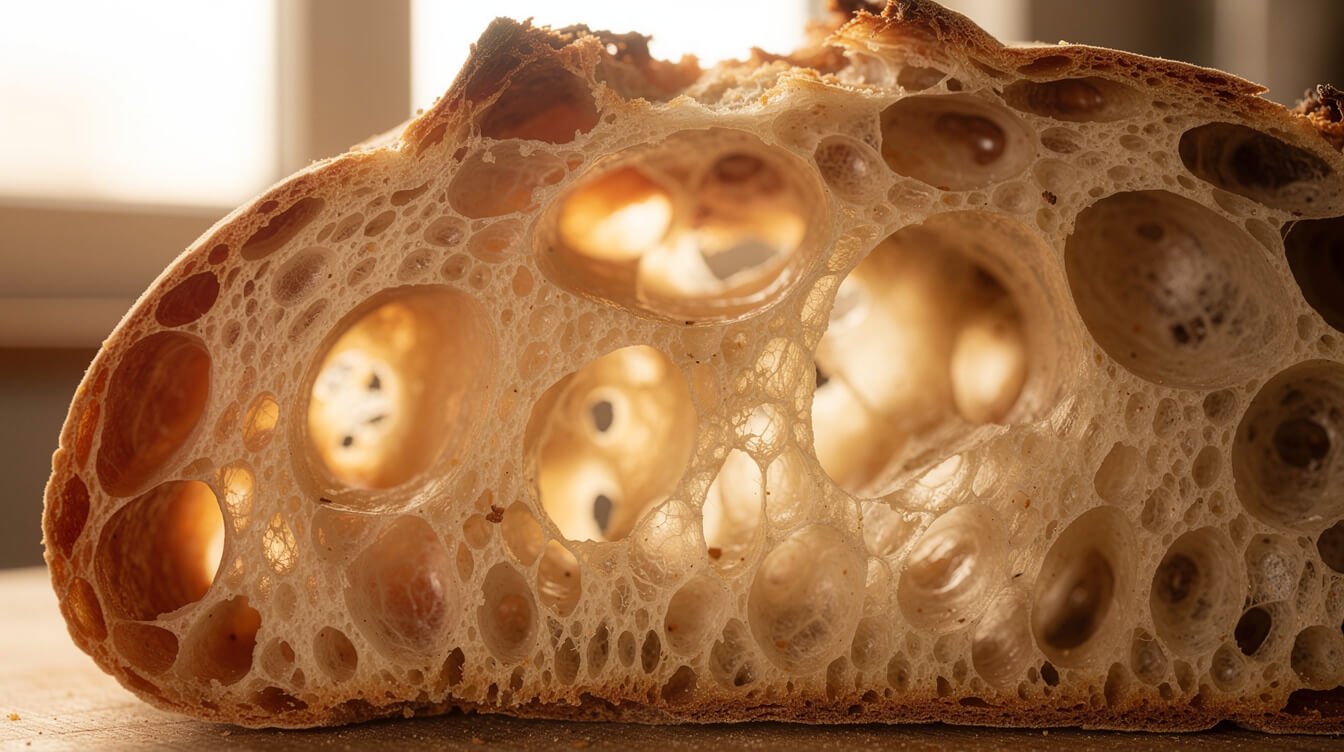
This is the part that makes sourdough croutons different from sandwich-bread croutons, and it is remarkable how little it gets said. Every top recipe for this exact search treats sourdough as a swappable bread — one of them tells you outright that you do not have to use sourdough at all.
But sourdough has an open, irregular crumb. Slice through a good loaf and you get thin papery webbing stretched around big holes in one spot, and a dense chewy patch near the bottom crust in another. Put both on the same tray at the same temperature and the webbing scorches while the dense patch is still bready. That is not your oven’s fault and it is not a mistake in your technique. It is the bread.
Four things fix it, and the first is the one that actually works:
- Sort as you cut. Two piles. Airy, hole-riddled pieces from the upper middle of the loaf in one; dense pieces from the bottom, the heel, and anywhere the crumb went tight in the other. Bake the dense pile first and add the airy pile to the pan after 8 minutes. Same tray, staggered start, even results.
- Cut with the holes, not across them. Look at the slice before you cut it into cubes. If you can place a cut so each piece keeps at least one solid wall rather than being pure lace, do it. A crouton made of nothing but webbing has no structure to hold.
- Stay at 350°F. A lower, longer bake is forgiving of uneven thickness. 400°F is not — see the next section.
- Toss more often. Every 8 minutes rather than once halfway. The thin pieces are the ones that catch, and they catch on whichever side is facing the pan.
Sourdough’s tang is part of why these are worth making at all — it stands up to a creamy soup in a way plain white bread does not. If you want more of it in your loaf next time, that is a fermentation question, and we go through it in how to make sourdough bread more sour.
If you are the person in your house who bakes the bread and therefore ends up dealing with the end of every loaf, you might like the one piece of merch we make: the Support Our Charities donor membership T-shirt, a plain black Gildan tee with a small logo on the chest and a big one on the back.
From the Eat Cafe kitchen
One good recipe a week, straight to your inbox
The recipe we're actually cooking this week, plus the one tip that saves it when it goes sideways. No spam. Unsubscribe anytime.
How much oil, and why 350°F beats 400°F for stale bread
Search this topic and you will get two oven temperatures with total confidence behind each and no reasoning attached to either. Two of the top results say 350°F. Two say 400°F. Nobody explains when you would want one over the other, so here it is.
350°F dries, 400°F browns. Croutons are not really baked, they are dehydrated. You are driving moisture out of the middle of each piece while the outside colors. At 350°F those two processes finish at roughly the same time, which is exactly what you want. At 400°F the outside browns well before the center has dried, and you get the classic result: a crisp shell over a chewy middle that goes soft in the container two hours later.
The one case for 400°F is bread that is already bone dry. There is no moisture left to drive out, so all you need is color and a bit of crisping, and 10 to 12 minutes at 400°F gets you there. If you are unsure which camp your loaf is in, use 350°F. It is nearly impossible to ruin croutons at 350°F, and quite easy at 400°F.
Worth knowing: extra virgin olive oil starts to smoke somewhere around 375 to 405°F. At 350°F you are comfortably under it. At 400°F you are sitting right at the edge, and scorched oil tastes bitter and will flatten everything else you seasoned with. Another quiet vote for the lower oven.
Oil, and why stale bread needs more of it
This one runs opposite to instinct. Dry bread is thirsty — the oil soaks straight in and disappears, so you need more of it. Fresher bread still holds water, so oil cannot penetrate and instead pools on the surface, which is what makes croutons greasy rather than crisp.
Per 8 ounces of bread: 2 tablespoons for day-old, 3 for properly stale, 3 to 4 for rock-hard torn chunks. With the hard stuff, toss it and then let it sit 5 minutes before it goes in the oven. You will watch the oil vanish into the bread, and that is the point — a second small drizzle after that rest is fine.
Under-oiled croutons come out pale, dusty, and tasteless no matter how long you bake them. If a batch tastes like nothing, oil is usually the reason, not salt.

Wear it on baking day
The Support Our Charities donor membership T-shirt is the only merch we make — a sturdy black Gildan tee, small logo on the chest, big one on the back. It is a good shirt for a Saturday spent up to your wrists in dough.
Oven, skillet, or air fryer — when each one is worth it
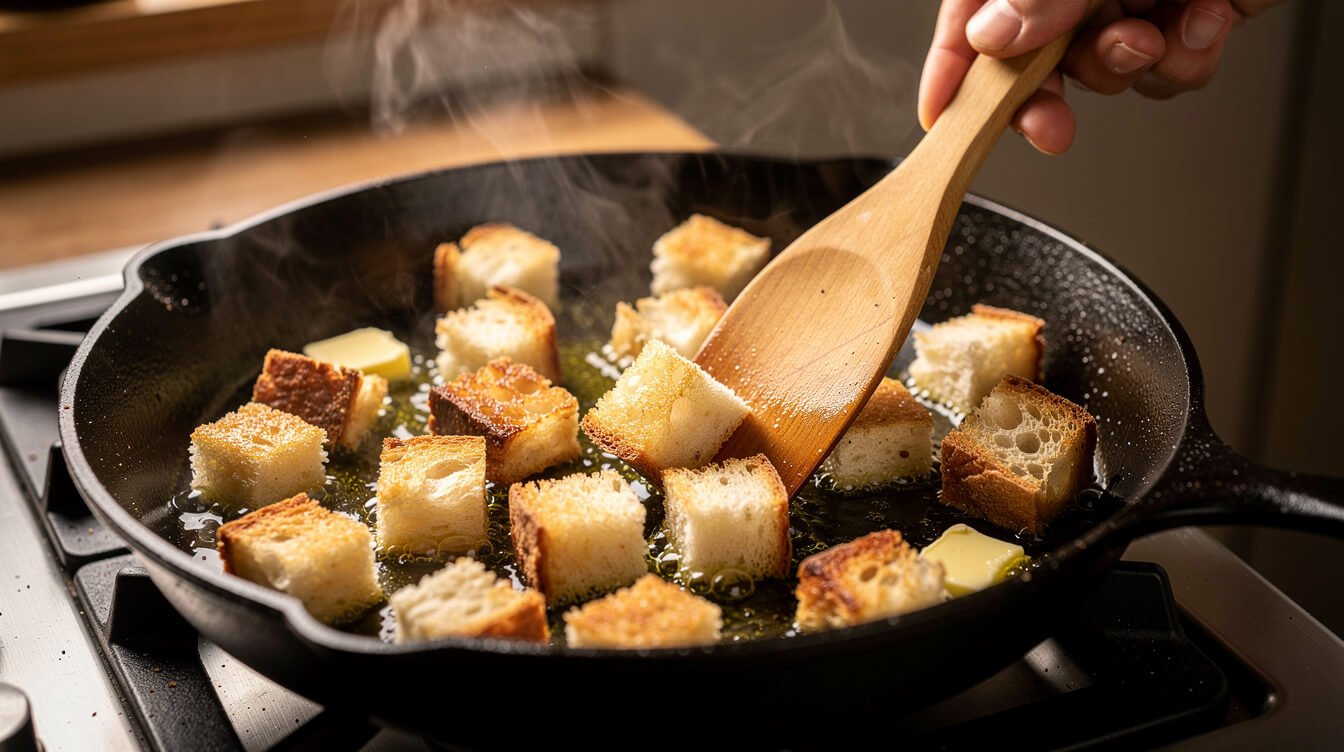
Three methods, three genuinely different reasons to pick them.
Oven: the default, and the only one for a big batch
Hands-off, even, and it scales. If you are making croutons for the week or for more than two people, this is the method. It is also the only one where you can run the staggered-tray trick from the open-crumb section. The downside is 25 minutes of oven time for something that is not the main event, so make them while something else is already baking.
Skillet: the best texture, for one or two servings
A cast iron or heavy skillet over medium heat, 2 tablespoons oil or a mix of oil and butter, torn chunks in a single layer, turning every minute or so for 6 to 8 minutes. The direct contact gives you a crackly, almost fried surface the oven cannot match, and dinner is 8 minutes away instead of 30.
Two cautions. Keep it at medium — butter and olive oil both brown fast and there is no recovering scorched fat. And do not crowd the pan; a second batch beats one steamy batch. If you are frying in deeper oil, dry bread only, no more than a third of the pan’s depth, and keep the heat moderate so the oil does not get away from you.
Air fryer: fast, small, and it will blow your seasoning off
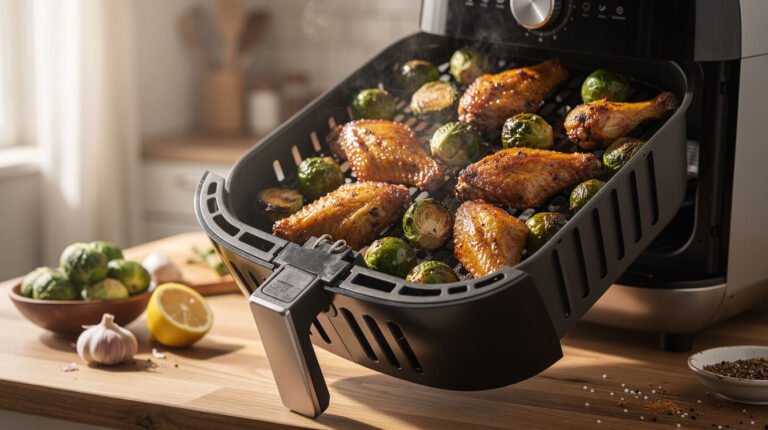
350°F for 6 to 8 minutes, shaking the basket twice. It is quick and it crisps well. But the basket holds maybe two cups, and the fan is strong enough to strip loose garlic powder and dried herbs right off the bread, so oil generously and season on the heavier side. Do not fill past a single loose layer — a packed basket steams exactly like a crowded sheet pan. If you are still finding your way around the machine, our air fryer guide for beginners covers the settings and the basics.
Seasoning: three combinations that actually taste like something
All three are per 8 ounces of bread, and all of them assume you already tossed with oil and salt.
Garlic, herb, and Parmesan. 1/2 teaspoon garlic powder and 1/4 teaspoon black pepper in with the oil. Then 1/4 cup finely grated Parmesan in the last 5 minutes only, and 1 tablespoon chopped fresh parsley or dill tossed on after the pan comes out. Timing is the whole trick: cheese added at the start burns, and fresh herbs added at the start turn black and taste like dust.
Butter and coarse black pepper. Swap 1 tablespoon of the oil for melted butter, add 1/2 teaspoon coarsely cracked pepper and a pinch of flaky salt. This is the Caesar-salad crouton, and it is the one people go back to the bowl for. Butter browns faster than oil, so knock 3 minutes off your bake time and start checking early.
Smoked paprika and cumin. 1/2 teaspoon smoked paprika, 1/4 teaspoon ground cumin, and a pinch of cayenne with the oil. Good on tomato soup, black bean soup, and anything with a fried egg on it.
One thing to avoid: fresh minced garlic. It burns in the time a crouton needs and turns acrid, which is why garlic powder earns its place here. If you want real garlic flavor, warm a smashed clove in the oil for a couple of minutes first, fish it out, and toss the bread in the infused oil. The same logic that makes garlic bread go bitter applies at crouton scale, only faster.
Storing them, and keeping them crunchy in soup
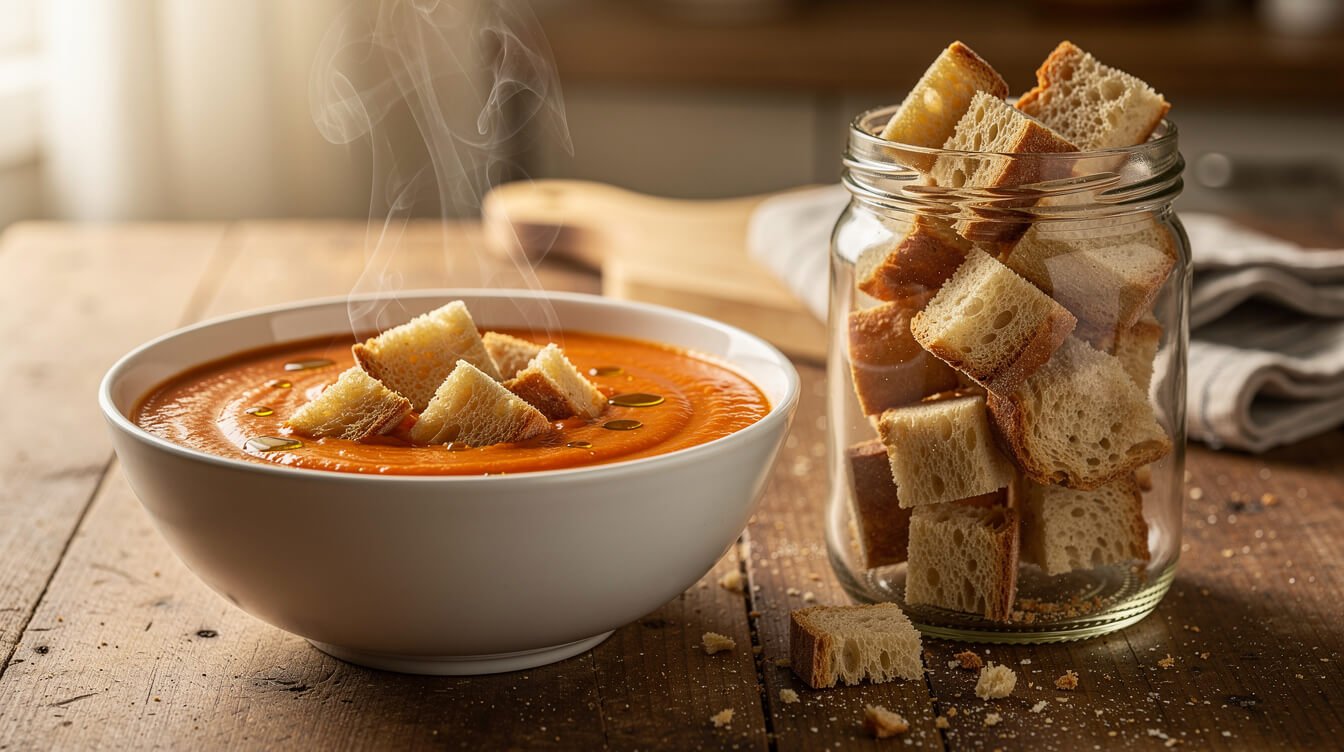
Storage
Cool them completely on the pan before they go anywhere. Not mostly cool — completely. Warm croutons in a sealed jar release steam, the steam has nowhere to go, and you get soft croutons at best and a moldy jar at worst.
Once cool, airtight at room temperature: plain oil-and-salt croutons keep about 2 weeks. Anything with Parmesan or butter in it keeps 4 or 5 days, because dairy is dairy. Skip the refrigerator, which is humid and will soften them. The freezer works well for up to 3 months in a zip-top bag; re-crisp straight from frozen, 5 minutes at 350°F.
Gone soft in the jar? They are not finished. Five to seven minutes at 350°F brings them right back, as long as there is no mold.
The soup problem
Most people looking up how to make croutons from sourdough bread are making them for a bowl of soup, so let me be straight with you: no crouton survives soup indefinitely. Anyone promising otherwise is selling something. What you can do is buy yourself a few good minutes instead of ninety seconds, and four things get you there.
- Bake soup croutons drier than salad croutons. Add 5 minutes. A crouton with any softness at its center collapses on contact; one that is crisp all the way through has to absorb its way in from the outside.
- Go bigger. A 1-inch cube has a far better volume-to-surface ratio than a 1/2-inch one, so it takes considerably longer to get to the middle.
- Use the fat and the cheese. A well-oiled crouton, and especially one with a Parmesan crust on it, resists water for noticeably longer than a dry one. This is the practical reason to oil properly.
- Add them at the table. Never into the pot, never into the bowl before you carry it. Put them in a small dish on the table and let people top their own.
Sourdough has an advantage here, by the way: a tight, well-fermented crumb holds together better in liquid than soft sandwich bread, which is part of why sourdough croutons are worth the trouble. A very open, airy loaf is the weaker choice for soup — save the lacy slices for salad and use the denser pieces for the bowl.
And croutons are not the only good end for a loaf on its way out. Stale bread is the whole premise of homemade Italian bread‘s next-day problem, and the same cubes make French toast, panzanella, or a breadcrumb jar.
How to make croutons from sourdough bread: your questions answered
Can I use fresh, same-day sourdough?
You can, and it will be worse. Fresh bread is full of water, so it compresses under the knife instead of cutting cleanly, it shrinks a lot, and the oil sits on the surface. If it is all you have, cut it 1 1/4 inches, use the low end of the oil, and either leave the cubes out uncovered for a few hours first or give them 10 minutes in a 250°F oven to dry before you oil them.
350°F or 400°F — which is actually right?
350°F for anything with moisture left in it, which is most loaves. 400°F only for bread that is already bone dry, and then just 10 to 12 minutes. When you cannot tell, 350°F is the safer choice by a wide margin.
Do I need to cut the crust off?
No. Leave it on. Sourdough crust is the best part of the crouton — it is already dry and it crisps hardest. The only exception is a crust so thick and tough it is genuinely unpleasant to chew, in which case trim the worst of it and keep the rest.
Butter instead of oil?
Yes, and it tastes better, but butter contains water and milk solids, so it browns faster and burns sooner. Use half butter and half oil, drop the oven 25 degrees or cut 3 to 5 minutes, and check early. Butter croutons also keep days rather than weeks.
How much bread per person?
About 1 ounce (30 g) of bread per serving as a salad topping, which is roughly 1/2 cup of finished croutons. The 8-ounce base recipe comfortably covers a salad or soup for four with some left for the jar.
Why are mine hard enough to hurt my teeth?
Overbaked, cut too big, or made from bread that was already very dry and then given a full bake anyway. Croutons should crack, not resist. Pull them when they are deep golden rather than dark brown, and remember they keep firming up as they cool.
Can I use bread that has a bit of mold on it?
No. Throw the loaf out. Bread is porous and mold grows threads well past the visible spot, so trimming it off does not make the rest safe. Hard, dry, and stale is fine to use. Fuzzy or discolored is not, and that holds no matter how good the loaf was.
Does it have to be sourdough?
Not at all — any sturdy bread makes good croutons, and a ciabatta or a rustic white loaf behaves almost identically. Sourdough just brings tang that holds up in a creamy soup, and its crust crisps particularly well. Soft sandwich bread works too, but cut it smaller and expect a lighter, more fragile crouton.
Can I make them a few days before a dinner party?
Yes, and it is a good idea. Make plain ones up to a week ahead, store them airtight at room temperature, then refresh them for 5 minutes at 350°F on the day and toss with fresh herbs or cheese right before serving.
Final thoughts
The reason crouton recipes feel unreliable is that they all describe one loaf, and you never have that loaf. Once you start with a thumb-press instead of a knife, the whole thing gets predictable: springy bread wants bigger cubes, less oil, and more time; stale bread wants smaller cubes and more oil; a rock-hard heel wants tearing and a cooler oven.
Add the one sourdough-specific move — sort the airy pieces from the dense ones and stagger them by 8 minutes — and the uneven tray stops happening. Stay at 350°F, oil more generously than feels right, cool them completely before they go in the jar, and put them on the table rather than in the pot.
That is genuinely all there is to how to make croutons from sourdough bread: a bowl of good soup and half a loaf saved. Not a bad Tuesday.

Before you go
Want the next one?
We post a new recipe or kitchen guide every day. The best of the week lands in one short email, no life story attached.