Best baking sheet for home bakers: what size, what metal, and why yours warps
The best baking sheet for most home cooks is a plain, uncoated aluminum half sheet pan with a rolled rim. It’s not fancy, it isn’t expensive, and it’s the pan nearly every cookie and sheet-pan recipe you’ll ever follow was written around. Buy two, add a wire rack that fits inside, and you’re set for cookies, roasted vegetables, sheet-pan dinners, and the Thanksgiving potatoes.
That’s the short answer. The rest of this guide covers the stuff the big review roundups skip: which size to get (half, quarter, jelly roll, and what actually fits your oven), whether dark pans really burn cookies, parchment versus a silicone mat, and why your pan goes bang in the oven and comes out twisted.
The best baking sheet for most home cooks: the quick answer
If you only read one section, read this one.
- Buy: an uncoated natural aluminum half sheet (about 18 x 13 inches), with a rolled or reinforced rim. Two of them, if you can.
- Add: a quarter sheet (about 13 x 9 inches) for small jobs, and a wire cooling rack that nests inside the half sheet.
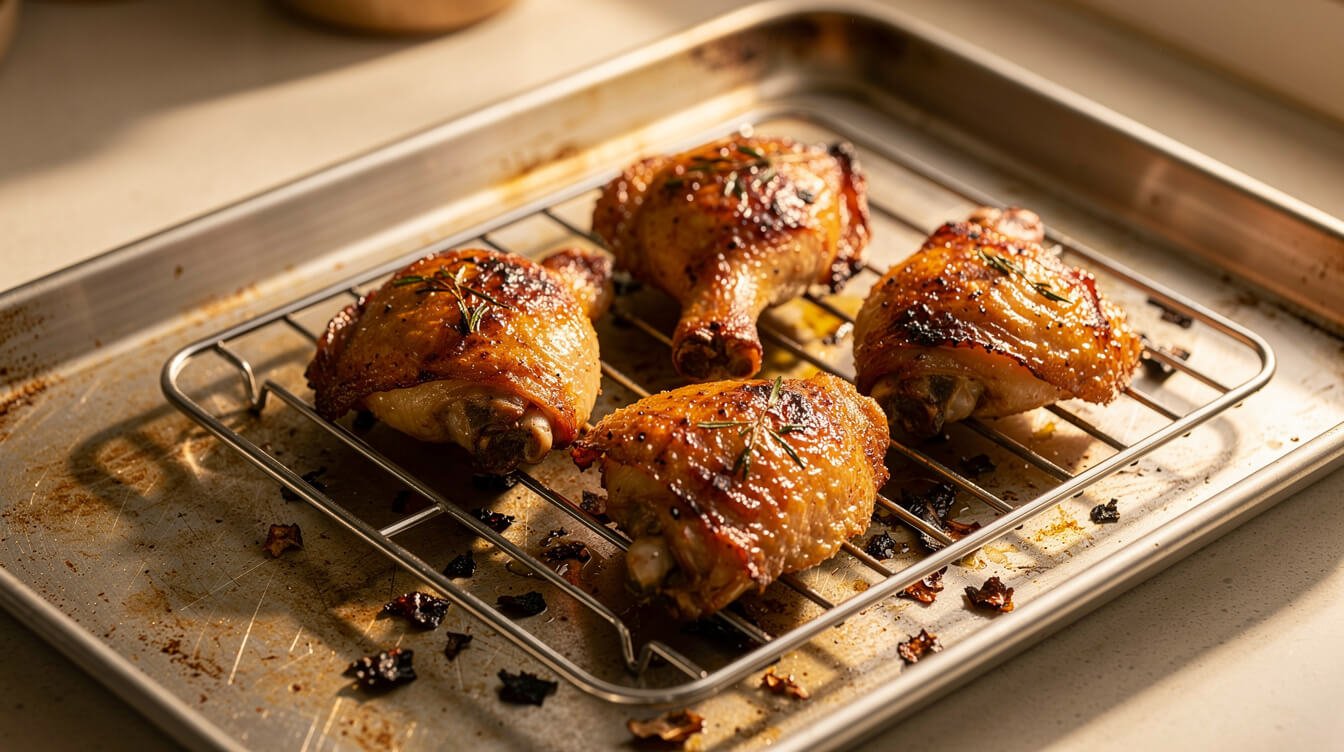
- Line it with parchment for cookies and sticky stuff. Leave it bare for roasting, when you want the browning.
- Skip thin, no-name pans that flex when you hold them by one corner. They warp fast and brown unevenly.
- Think twice about nonstick as your main pan. It’s handy for a few jobs, but the coating wears out, and cookies tend to spread more on it.
Why aluminum? It heats up fast and cools down fast, so cookies set before they spread and vegetables brown instead of steaming. It’s also light enough to pull out of the oven one-handed with a full load on it. And because most recipes were developed on exactly this kind of pan, your bake times will actually match what the recipe says.
The honest catch: plain aluminum stains and darkens with use, it can’t go in the dishwasher, and even a good one may warp a little after years of heavy use. None of that affects your food. A stained sheet pan is a well-loved sheet pan.
The best baking sheets, ranked (and the catch with each)
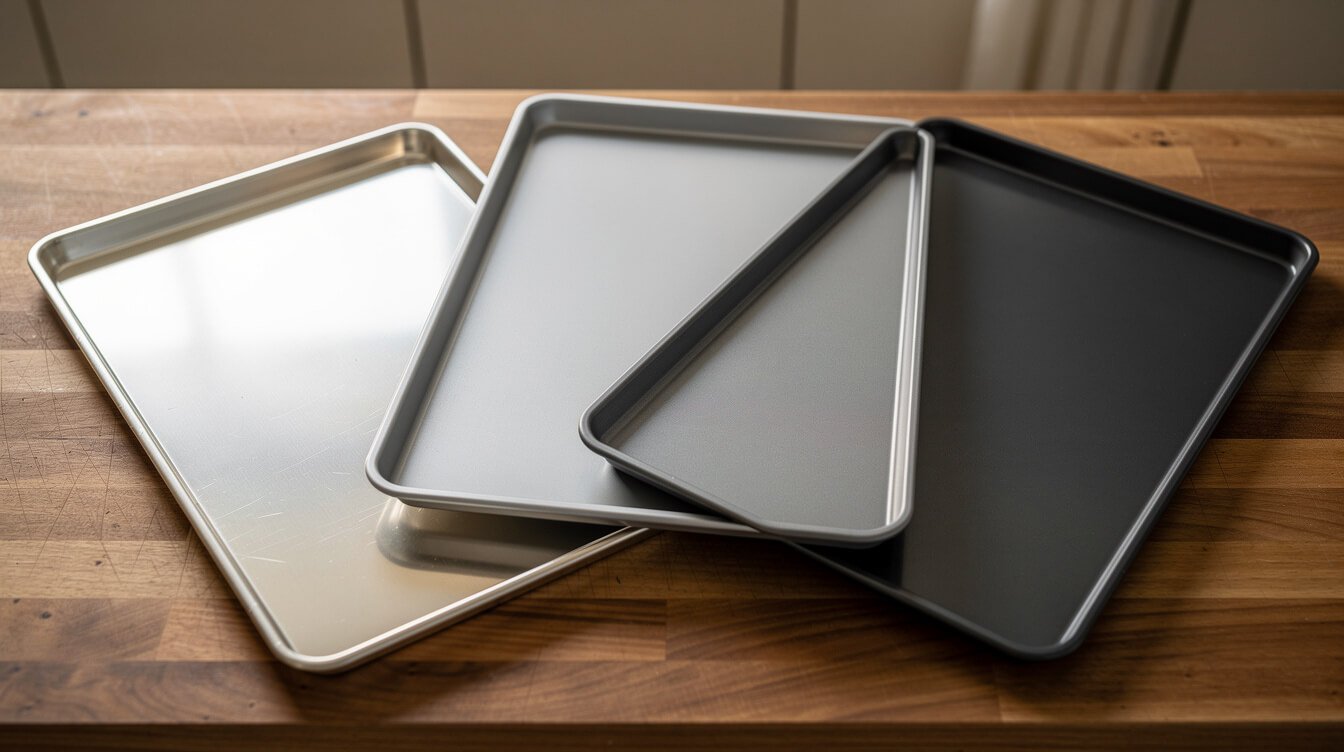
These are the pans that keep coming out on top in the major test-kitchen reviews this year, sorted by what you need them for. Prices move around a lot, so treat these as rough ranges at the time of writing, not fixed numbers.
1. Best overall: Nordic Ware Naturals Baker’s Half Sheet
Natural aluminum, about 1.6 pounds, with a steel-reinforced rolled rim that helps it resist warping. It’s the top pick at Bon Appétit, America’s Test Kitchen, and Reviewed, and it’s usually around $15 to $20 for one, or around $35 for a two-pack. It browns evenly, it’s light, and it fits standard wire racks snugly.
The catch: it’ll stain and dull over time, it’s hand-wash only, and acidic foods (tomatoes, vinegar, citrus) can discolor bare aluminum. Line it with parchment for those.
2. Best heavy-duty budget pick: Chicago Metallic Commercial II (uncoated)
This one’s aluminized steel (steel coated in an aluminum alloy), so it’s heavier, about 2.25 pounds, and stiffer. Food Network named it best overall. It’s often around $15 to $20. If your old pans keep twisting, this sturdier build is worth a look.
The catch: the extra weight means it heats a little slower than pure aluminum. For most cookies and roasting you won’t notice, but your first batch is worth watching.
3. Best quarter sheet: a natural aluminum quarter sheet (Nordic Ware or similar)
The small sibling of the overall pick, about 13 x 9 inches outside. It’s perfect for toasting nuts, roasting one tray of vegetables, a half batch of cookies, or reheating leftovers without heating up a big pan. It also fits many larger toaster ovens (measure yours first).
The catch: none really, except that you’ll start using it for everything and want a second one.
4. Best nonstick (if you want one): Chicago Metallic Professional Nonstick
If you roast a lot of sticky, glazed, or cheesy things and hate scrubbing, a nonstick half sheet is handy. This one has a reinforced rim and is one of the few nonstick sheets the maker says is fine with metal utensils.
The catch: every nonstick coating eventually wears out. Cookies spread more on slick surfaces. And always follow the maker’s maximum oven temperature. Don’t put a nonstick pan under the broiler unless the maker says it’s OK.
5. Splurge for acidic foods: clad stainless steel
Fully clad stainless sheet pans (aluminum sandwiched between stainless) don’t react with tomatoes, citrus, or vinegar, and they resist scratches. ATK’s stainless pick was the Williams Sonoma Thermo-Clad half sheet.
The catch: they cost $100 or more, weigh two to three times as much, and often aren’t standard sizes, so your wire rack may not fit. They also behave differently from the aluminum pans most recipes were tested on, so bake times can be off. Worth it only if you roast a lot of acidic food.
The one we’d skip
Thin, flimsy pans from multi-piece bakeware sets. If it bends when you hold it by one corner, it’ll pop and twist in a hot oven, and your vegetables will slide into one wet pile. You’ll end up buying a real half sheet anyway, so start there.
Baking sheet sizes, explained: half, quarter, jelly roll, and cookie sheet
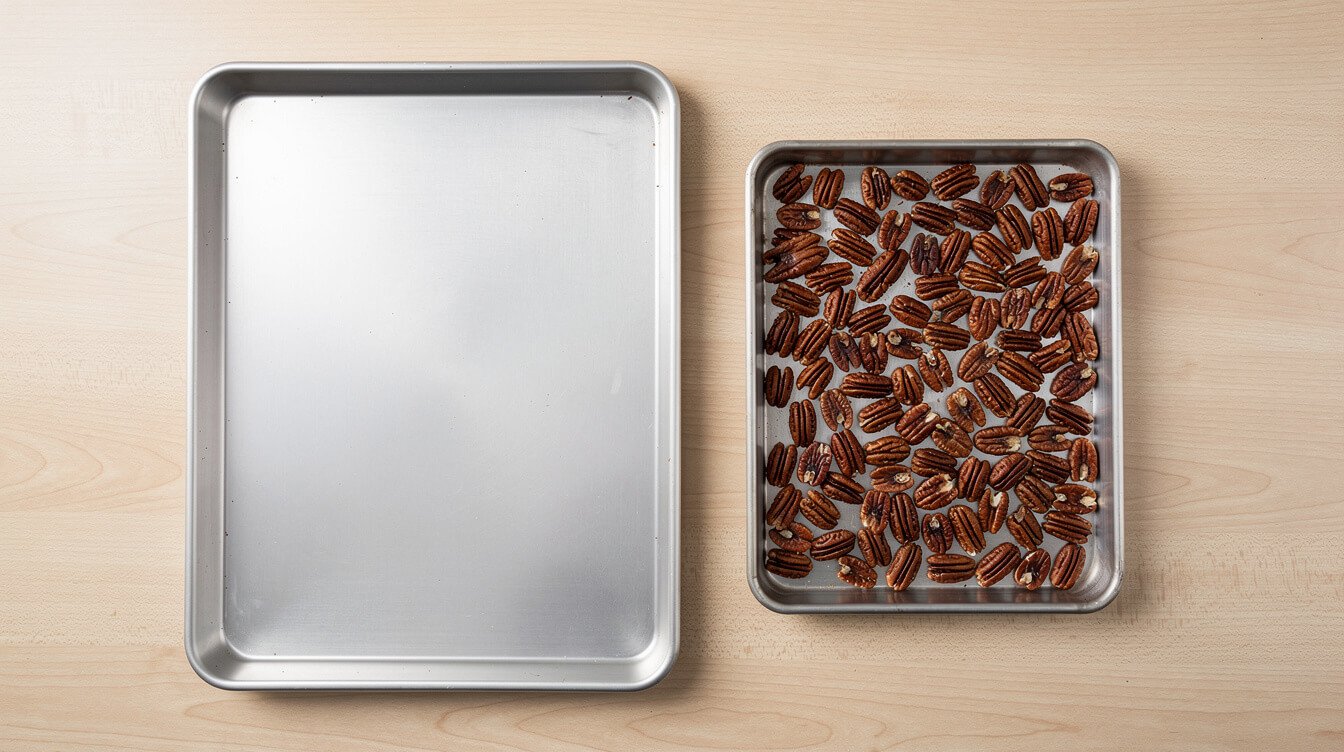
This is where most people get confused, because the names don’t explain themselves. “Half sheet” means half of a commercial bakery’s full sheet pan, which is too big for a home oven.
| Name | Outside size (approx.) | Cooking surface (approx.) | Best for |
|---|---|---|---|
| Full sheet | 26 x 18 in | — | Bakeries only. It won’t fit a home oven. |
| Half sheet | 18 x 13 in | about 16½ x 11½ in | Almost everything: cookies, sheet-pan dinners, roasting |
| Quarter sheet | 13 x 9 in | about 11½ x 8½ in | Small batches, nuts, toaster ovens, prep trays |
| Eighth sheet | about 9½ x 6½ in | about 8¾ x 5½ in | Tiny jobs, small toaster ovens, holding spices by the stove |
| Jelly roll pan | about 15 x 10 in (varies) | varies by brand | Thin sheet cakes for rolling. Fine for a small batch of cookies. |
| Cookie sheet | varies | flat, with no rim (or one raised edge) | Cookies only. Slides off easily, but it can’t hold juices. |
Will it fit your oven?
A standard 30-inch range fits a half sheet with room to spare. But compact ovens, wall ovens in older kitchens, and RV ovens vary a lot. Measure the inside of your oven, side to side and front to back, and leave at least an inch or two of space around the pan so hot air can move. A pan that touches the walls bakes unevenly and blocks airflow to the rack below.
Rimmed or rimless?
Rimmed. A rimmed half sheet bakes cookies just fine and also catches chicken juices, holds a wire rack, and keeps roasted potatoes from rolling onto the oven floor. A rimless cookie sheet only does cookies. If you bake a lot of cookies and like sliding the parchment straight off, one rimless sheet is a nice extra. You can also just flip a rimmed pan upside down.
How many do you actually need?
For most households: two half sheets and one quarter sheet, plus a wire rack for each half sheet. Two half sheets let you bake one tray while you load the next, and that’s the setup almost every cookie recipe, from our best chocolate chip cookies to soft gingerbread molasses cookies, assumes. Add a third half sheet if you host big holidays.
Aluminum vs aluminized steel vs nonstick vs insulated: what each is good at
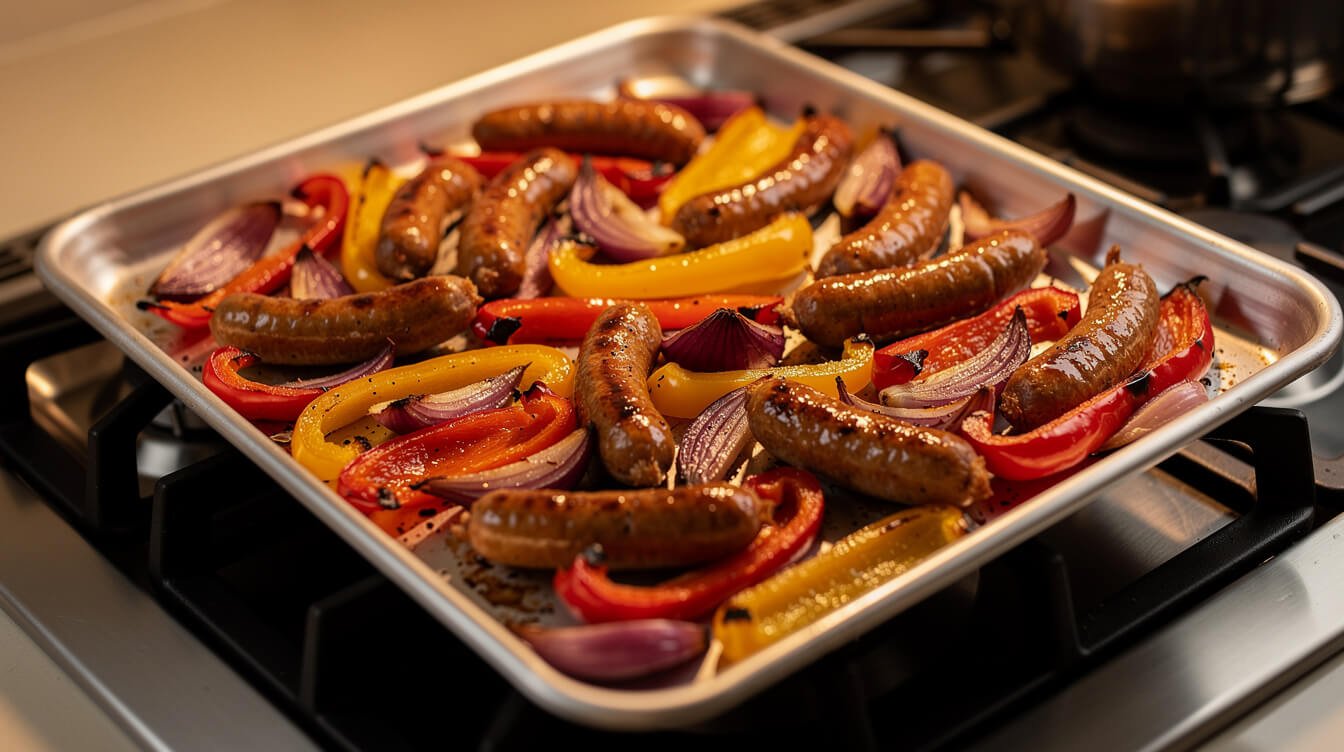
The material decides how fast the pan heats, how much it browns, and how long it lasts. Here’s the plain version.
Natural aluminum
Heats and cools fast, browns evenly, and it’s light and cheap. It’s what most recipes are written for. The downsides: it stains, it’s hand-wash only, and it can react with acidic foods. Tomatoes or a vinegary marinade sitting on bare aluminum can discolor the pan and give food a slightly metallic taste, so line it with parchment for those. Best for: nearly everything.
Aluminized steel
Steel with an aluminum-alloy coating. It’s heavier and stiffer than aluminum, so it resists warping and dents well, and it heats a little more slowly. Many commercial kitchens use it. Best for: anyone who’s warped a few aluminum pans, or who roasts at high heat a lot.
Nonstick-coated
Easy release and easy cleanup, especially for sticky glazes, cheese, and bar cookies. But the coating scratches and wears, cookies spread flatter on it, and it usually has a lower maximum oven temperature than bare metal. Use silicone or wooden tools unless the maker says metal is fine, follow the maker’s top temperature, and keep it out from under the broiler unless the maker says otherwise. Best for: a second pan for sticky jobs, not your only one.
Insulated (double-layer)
Two sheets of metal with an air gap between them. The bottoms of your cookies stay pale and soft, which some bakers love for delicate cookies and shortbread. But the pan heats slowly, so cookies often need extra minutes, and it’s poor for roasting, where you want strong bottom heat. Best for: pale, soft cookies. Not a first pan.
If you’re building out your kitchen from scratch and wondering what else is worth the money after a good sheet pan, our 100 Essential Tools Every Chef Has in Their Kitchen guide walks through what to buy first and what you can happily skip.
From the Eat Cafe kitchen
One good recipe a week, straight to your inbox
The recipe we're actually cooking this week, plus the one tip that saves it when it goes sideways. No spam. Unsubscribe anytime.
Dark vs light pans, and corrugated vs flat: what changes in your cookies
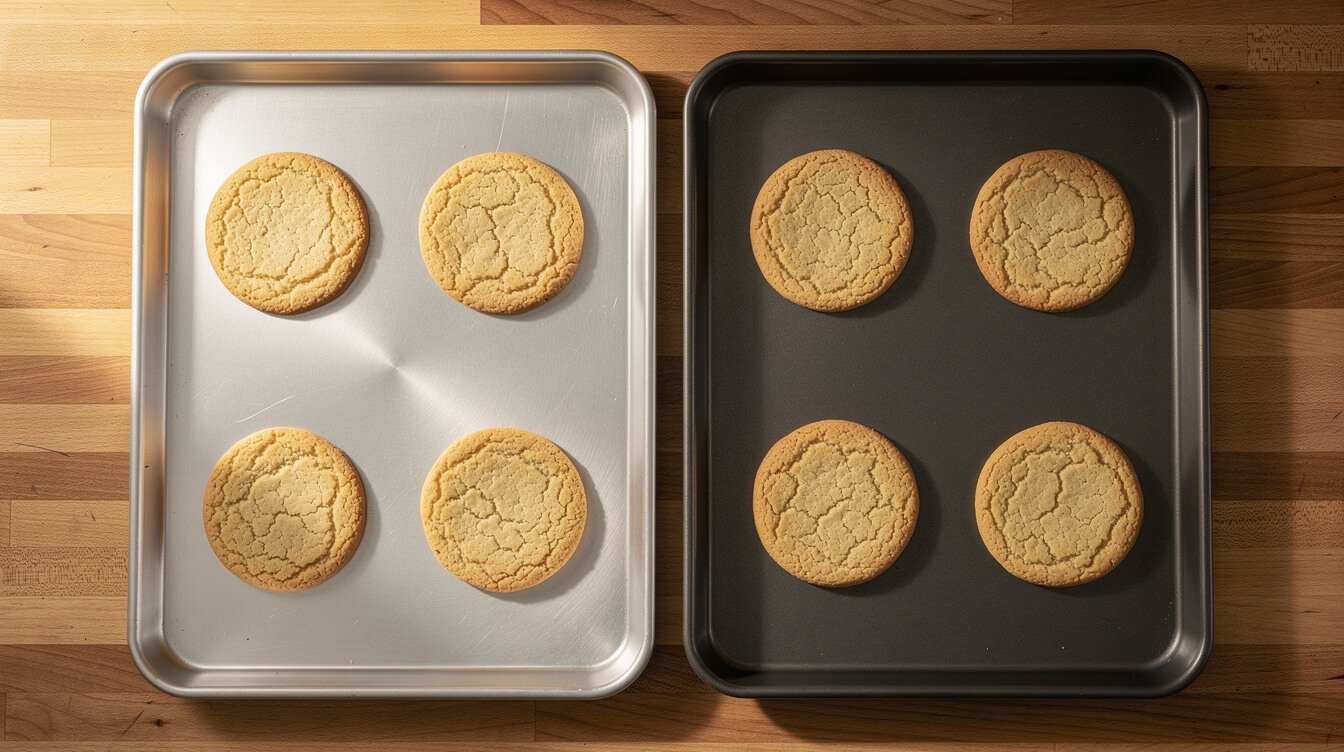
Dark pans brown the bottoms faster
This one’s real. A dark surface absorbs more of the oven’s heat than a shiny, light one, so cookie bottoms, pizza crusts, and roasted potatoes brown faster on a dark pan. That’s great for roasting and frustrating for cookies, where you can end up with a dark, bitter bottom and an underbaked middle.
If you bake on a dark pan:
- Check early. Start looking 2 to 3 minutes before the recipe’s lower time.
- Follow the pan maker’s guidance. Many dark-pan makers suggest lowering the oven by about 25°F. Check the instructions that came with yours.
- Line it with parchment. It softens the bottom heat a little.
- Bake one tray at a time in the middle of the oven, so the bottom tray isn’t sitting closer to the heat.
A light aluminum pan that’s gone gray and stained with use doesn’t count as “dark” in the same way. It’ll brown a bit faster than when it was new, which most cooks like.
Corrugated vs flat
Some pans, like USA Pan’s, have a ridged, textured surface. The idea is a stiffer pan and a little air under the food. In practice, the cookie difference is small. The bigger real-world difference is cleanup: grease and crumbs settle in the grooves, so it takes more scrubbing. If you love the one you’ve got, keep it. If you’re buying new, flat is easier to live with.

100 Essential Tools Every Chef Has in Their Kitchen
A good sheet pan is one tool. This eBook and guide goes through the rest of the kitchen the same way: what earns its spot, what to buy first, and what’s just nice to have.
Parchment vs silicone mat vs nothing: which to use when
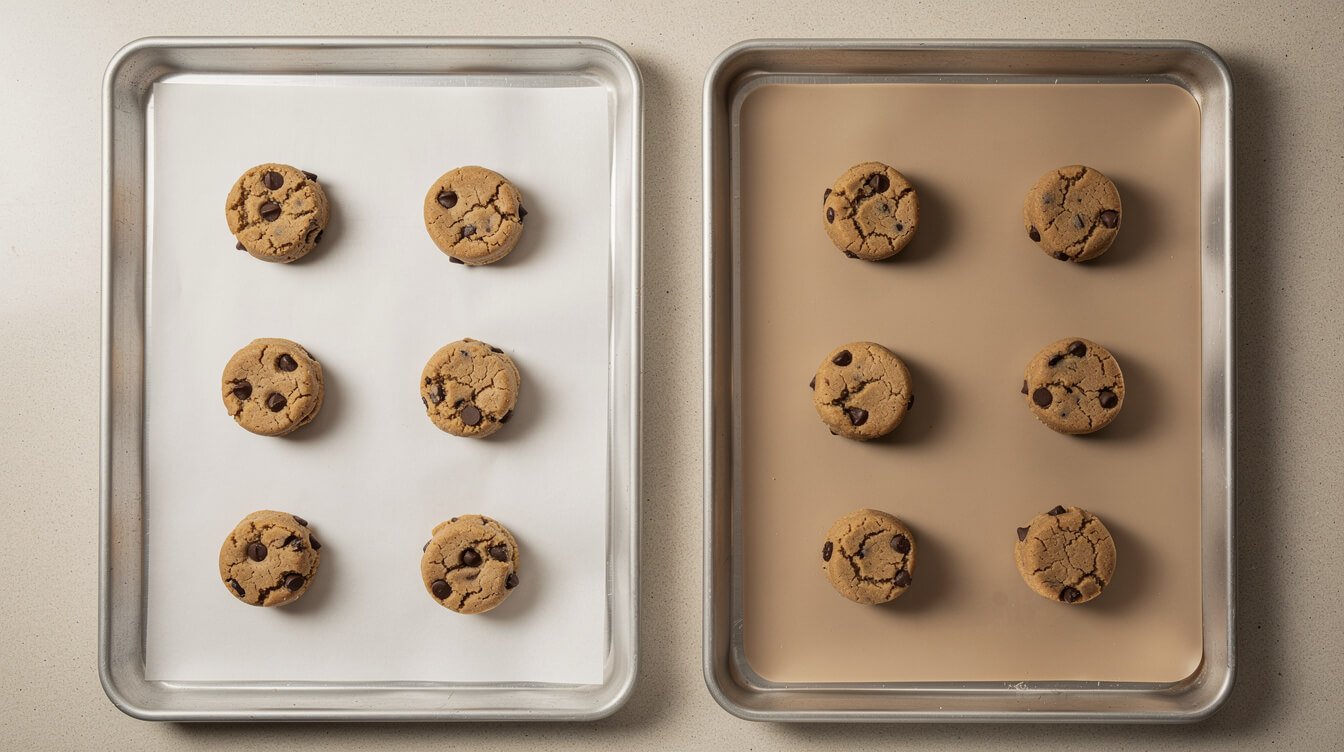
This is one of the most-asked questions about sheet pans, and the honest answer is that each one has a job.
| Liner | Good at | Not so good at |
|---|---|---|
| Parchment paper | Cookies (even bottoms, easy release), anything acidic on aluminum, fast cleanup, lifting a whole batch off to cool | Very high heat. Check the box for its temperature limit, and never put it under the broiler. |
| Silicone baking mat | Sticky things: caramel, candied nuts, cheese crisps, glazed anything. It’s reusable. | Crisp bottoms. It insulates slightly, so bottoms brown a little less and some cookies spread a bit more. Don’t cut on it. |
| Nothing (bare pan) | Roasting vegetables and potatoes. Direct contact with hot metal gives the best browning. | Cookies (they can stick), and anything acidic on bare aluminum |
| Foil | Very messy jobs and easy cleanup, like sticky barbecue glazes | Delicate cookies (they stick), and it’s single-use |
One thing to never swap in: wax paper is not parchment. Wax paper’s coating melts and smokes in the oven. Keep it for wrapping and counter work, not baking.
For cookies specifically, parchment is our everyday pick. It gives the most even, golden bottoms, it lets you slide a whole batch onto a rack in one move, and you can reuse a sheet for a couple of batches. That’s how we bake bakery-style chocolate chip cookies and our cut-out sugar cookies for decorating.
Why baking sheets warp, and how to stop it
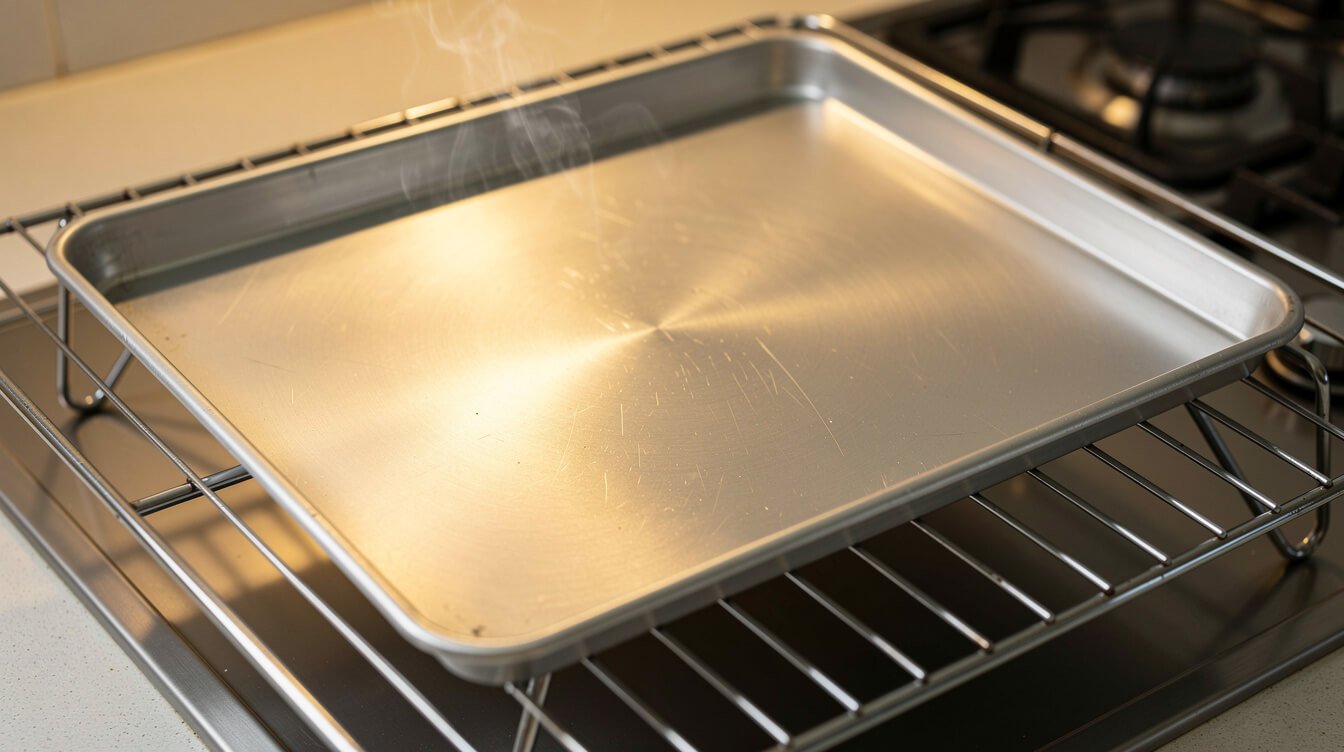
That loud bang from the oven is the metal twisting. Metal expands as it heats. When part of the pan is much hotter or colder than the rest, the parts expand by different amounts, and the pan buckles. It usually happens when:
- The pan is thin. Thin metal has nothing to resist the twist.
- It’s preheated empty at high heat. This is the classic warp trigger, common when you heat a pan for crispier potatoes.
- Cold food hits a hot pan, so one area suddenly cools while the rest stays hot.
- Food is bunched on one side, leaving the other half bare and much hotter.
- Cold water hits a hot pan. This is the one most likely to make the warp permanent.
How to stop it
- Buy a heavier pan with a rolled or reinforced rim. That’s the biggest factor.
- Spread food evenly across the whole pan.
- Only preheat an empty pan when the recipe really benefits from it, and don’t leave it in there longer than needed.
- Let a hot pan cool on the stovetop or a rack before it goes anywhere near the sink.
Good news: most warping is temporary. Once the hot and cool spots even out, many pans pop back flat on their own. If yours stays a little bowed and still sits mostly flat, it’s fine for roasting. If it rocks or spins on the counter, retire it to toasting nuts and buy a sturdier one. Aluminum is easy to recycle.
Care and cleaning: stains are normal, the dishwasher isn’t
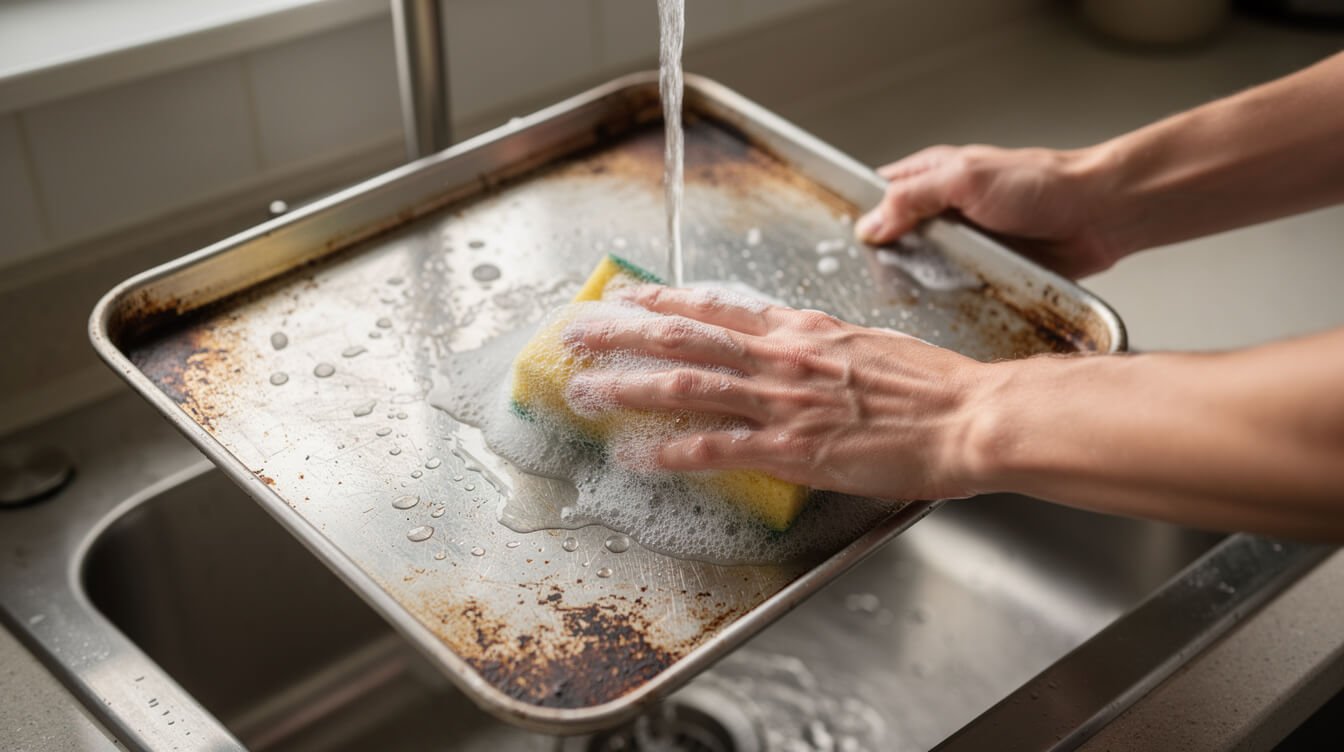
A brand-new aluminum pan is shiny. A year later it’s gray, with brown patches around the edges. That’s baked-on oil, it’s normal, and it doesn’t hurt your food. You don’t need to scrub it back to new. Many bakers think a slightly darkened pan browns better.
The routine
- Let it cool before washing (see the warping section above).
- Soak stuck-on bits in hot, soapy water for 10 to 15 minutes.
- Scrub with a sponge or nylon scrubber. For stubborn spots on bare aluminum or stainless, a paste of baking soda and a little water, or a cleanser made for cookware, works well. On nonstick, stick to the soft side of the sponge.
- Dry right away, especially aluminized steel. It can rust at scratches and edges if left wet.
What about the dishwasher?
- Natural aluminum: no. Dishwasher detergent permanently discolors and roughens bare aluminum.
- Clad stainless: hand-wash is safer. Repeated dishwasher cycles can wear the exposed aluminum core at the edges.
- Nonstick and aluminized steel: some say dishwasher-safe, but almost every maker still recommends hand-washing to make the pan last longer.
The same “it’s seasoned, not dirty” mindset applies to a cast iron skillet and a well-used Dutch oven. The gear that looks worn in is usually the gear that works.
Best baking sheet: frequently asked questions
What’s the best baking sheet for cookies?
A light, uncoated aluminum half sheet, lined with parchment. It gives even, golden bottoms and bakes to the times in most recipes. If you want very pale, soft-bottomed cookies, an insulated sheet does that, but expect longer bake times.
What’s the difference between a sheet pan and a cookie sheet?
A sheet pan has a rim on all four sides, usually about an inch high. A cookie sheet is flat, with no rim or just one raised edge for grabbing. Sheet pans do everything. Cookie sheets only do cookies, but they let you slide cookies off easily.
Is a jelly roll pan the same as a quarter sheet?
No. A jelly roll pan is usually about 15 x 10 inches, between a quarter sheet (13 x 9) and a half sheet (18 x 13). If a recipe calls for a jelly roll pan, a half sheet will make a thinner cake that bakes faster, so check it early.
Why do my cookies burn on the bottom?
The usual causes are a dark pan, a rack set too low, or a thin pan that runs hot. Move the rack to the middle, line the pan with parchment, check a few minutes early, and if your pan is dark, follow the maker’s advice about lowering the temperature. An oven thermometer is also worth a few dollars, since many ovens run hot. If your cookies also spread flat, our baking basics for beginners covers the usual dough-side fixes.
Can I use a glass baking dish instead of a baking sheet?
For casseroles, yes. For cookies and roasting, no. Glass heats slowly and holds heat, so bottoms cook unevenly and nothing crisps like it does on metal. Don’t put glass bakeware under the broiler or move it straight from the fridge into a hot oven unless the maker says it’s safe.
Do I need to replace a stained baking sheet?
No. Stains and discoloration are cosmetic. Replace a pan when it’s badly warped (it rocks on a flat counter), when a nonstick coating is peeling or flaking, or when aluminized steel is rusting through.
What size baking sheet fits a toaster oven?
Many larger countertop ovens take a quarter sheet. Smaller ones need an eighth sheet or the tray that came with the oven. Measure the inside, and leave some space around the pan for air.
Is the best baking sheet worth paying more for?
Up to a point. The difference between a $5 thin pan and a $15 to $20 commercial-style aluminum half sheet is huge. The difference between that and a $100 clad stainless pan is small for most home cooks.
The short version
The best baking sheet for most home kitchens is the plain one: an uncoated aluminum half sheet with a rolled rim, two of them, plus a quarter sheet and wire racks that fit inside. Line it with parchment for cookies, leave it bare for roasting, keep it out of the dishwasher, and don’t run cold water over it when it’s hot.
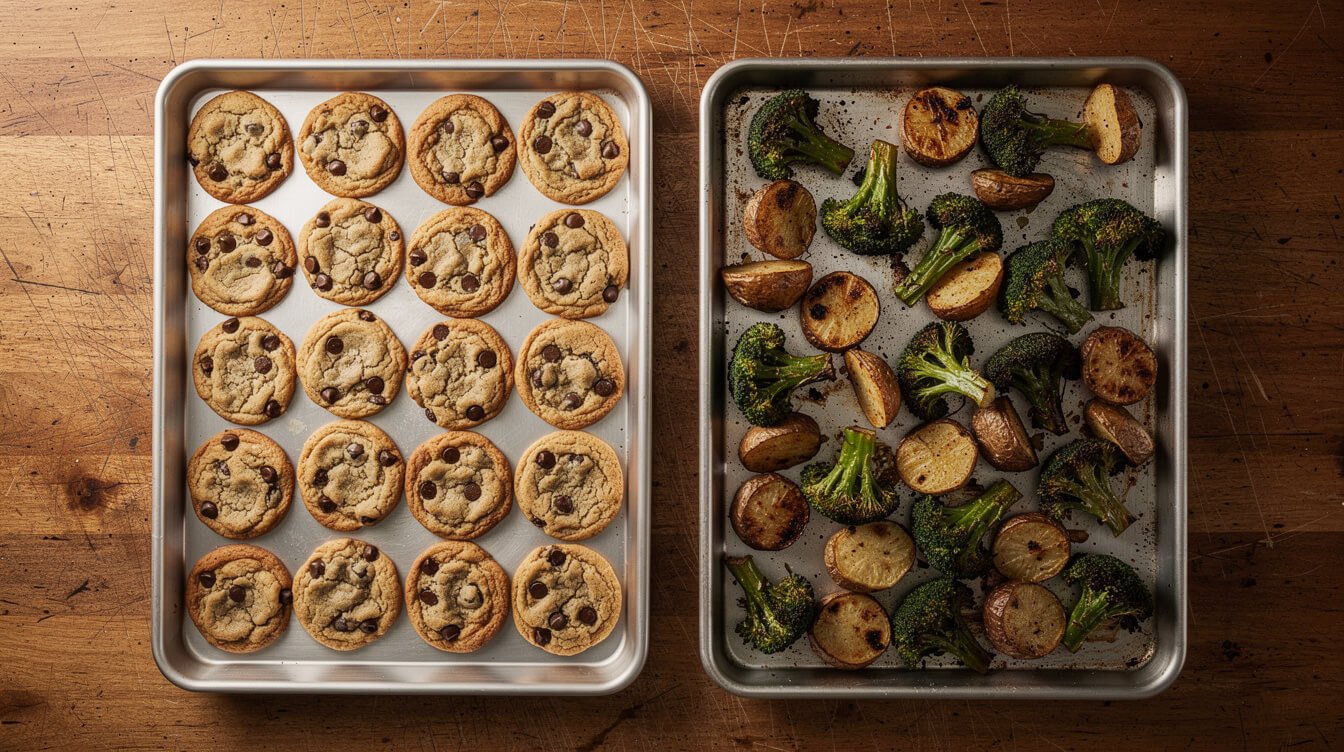
Then use it. Roast a tray of potatoes and broccoli on a Tuesday, bake garlic bread alongside, or put it under a batch of dinner rolls for the holidays. The stains it collects along the way are part of the deal.

Before you go
Want the next one?
We post a new recipe or kitchen guide every day. The best of the week lands in one short email, no life story attached.