Cookie press spritz cookies: the buttery dough that actually sticks to the pan (and fixes when it won’t)
You loaded the cookie press, lined up the sheet, squeezed the trigger, and lifted it to find nothing there. Or worse, a perfect little wreath came up stuck to the bottom of the press while the pan stayed bare. That’s the most common way cookie press spritz cookies go wrong, and most recipes skip right past it. This one doesn’t. Below is a buttery, reliable spritz dough, and the short list of things that decide whether it sticks to the pan: soft (not melty) butter, a dough you never chill before pressing, and a bare, cool, unlined baking sheet.
The recipe comes first, so you can just bake. After that you’ll find why spritz dough behaves differently from other cookie doughs, a step-by-step for the press, a troubleshooting table for every way it fails, how to make spritz with no press at all, and how to decorate, store, and freeze them for the holidays.
Cookie press spritz cookies: the recipe
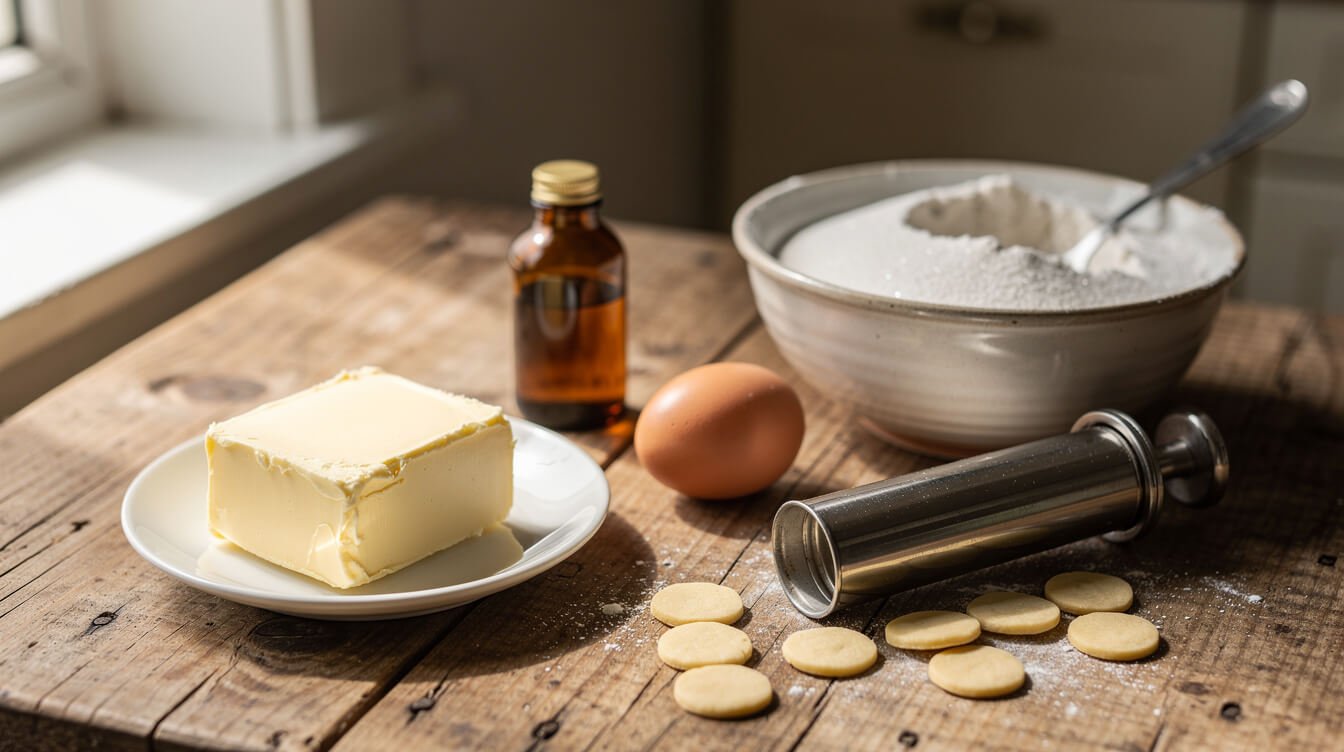
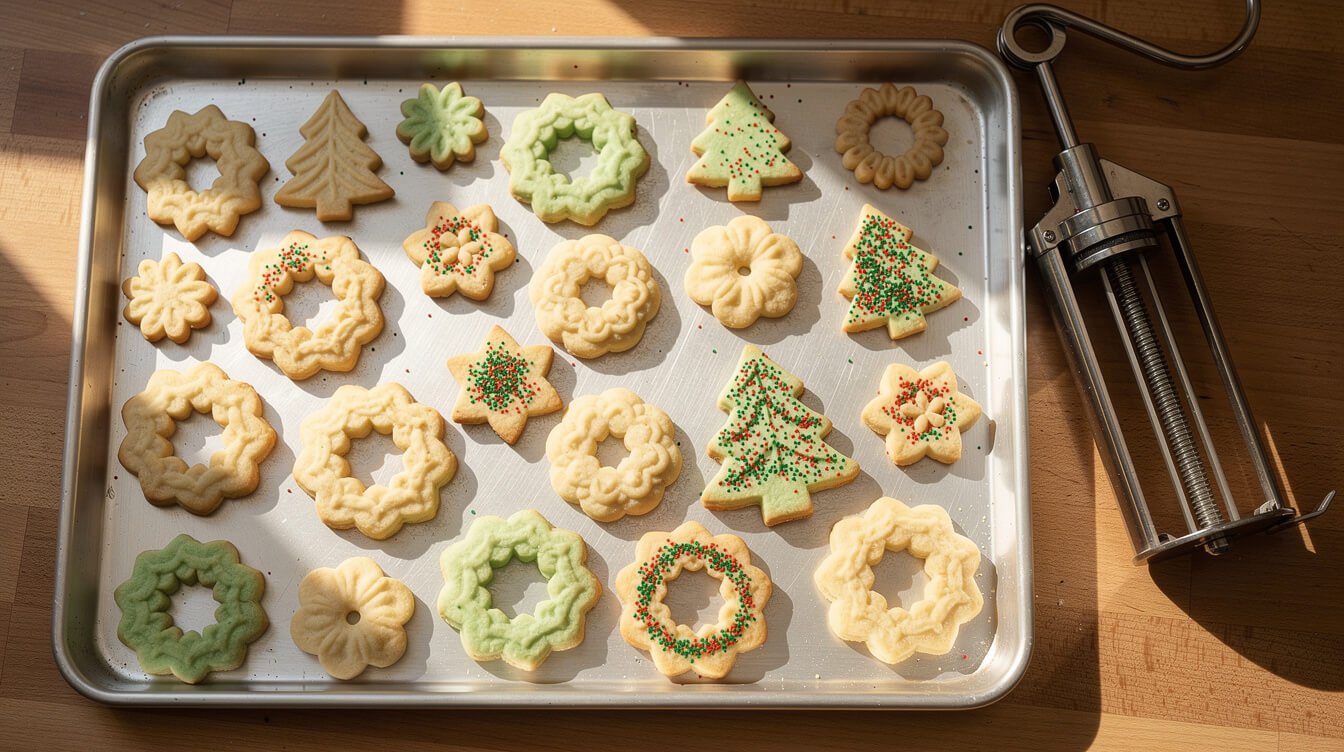
This makes about 6 dozen small cookies, depending on your disks. Hands-on time is around 30 minutes, and there’s no chilling. Spritz are a crisp, tender, buttery cookie, a bit like shortbread but lighter. The vanilla and the hint of almond are what make people say “oh, these” when they see them on a tray.
Ingredients
- 1 cup (2 sticks, 226g) unsalted butter, softened to room temperature
- 2/3 cup (133g) granulated sugar
- 1 large egg, at room temperature
- 1 1/2 teaspoons vanilla extract
- 1/2 teaspoon almond extract (optional, but it’s the classic flavor)
- 1/2 teaspoon fine salt (use 1/4 teaspoon if your butter is salted)
- 2 1/4 cups (281g) all-purpose flour, spooned into the cup and leveled
- Optional: gel food coloring, sprinkles, colored sugar
Method
- Heat the oven to 375°F (190°C). Set out 2 or 3 bare metal baking sheets. Don’t grease them, and don’t line them with parchment. If you have room, put them in the fridge while you make the dough. A cool sheet grabs the dough better.
- Cream the butter and sugar. Beat on medium for about 2 minutes, until pale and fluffy. Scrape the bowl.
- Add the egg, vanilla, almond extract, and salt. Beat until smooth, about 30 seconds.
- Add the flour on low speed and mix just until no dry streaks remain. The dough should be soft, smooth, and hold a fingerprint without feeling sticky or greasy. If you’re tinting it, divide the dough and knead in gel color now.
- Fill the press and shape. Pack the dough into the barrel, attach a disk, and hold the press straight up and flush against the sheet. Squeeze one full click, then lift straight up. Space cookies about 1 inch apart. Add sprinkles before baking.
- Bake 7 to 9 minutes, until the bottoms and the very edges are just barely golden. The tops should stay pale.
- Cool 2 minutes on the sheet, then move to a rack with a thin spatula. Let the sheet cool completely (or rinse it under cold water and dry it) before you press the next batch.
Allergen note: this recipe contains wheat, egg, and dairy, plus almond extract, which some people with tree-nut allergies avoid. Leave the almond extract out and use 2 teaspoons of vanilla instead if you’re baking for someone who needs it. That’s a flavor swap, not an allergy-safe guarantee, so check labels on everything that goes in.
And one honest note: don’t taste the raw dough. It has raw flour and raw egg, and neither is meant to be eaten uncooked. The baked cookies are worth the wait.
What makes spritz dough different from other cookie doughs
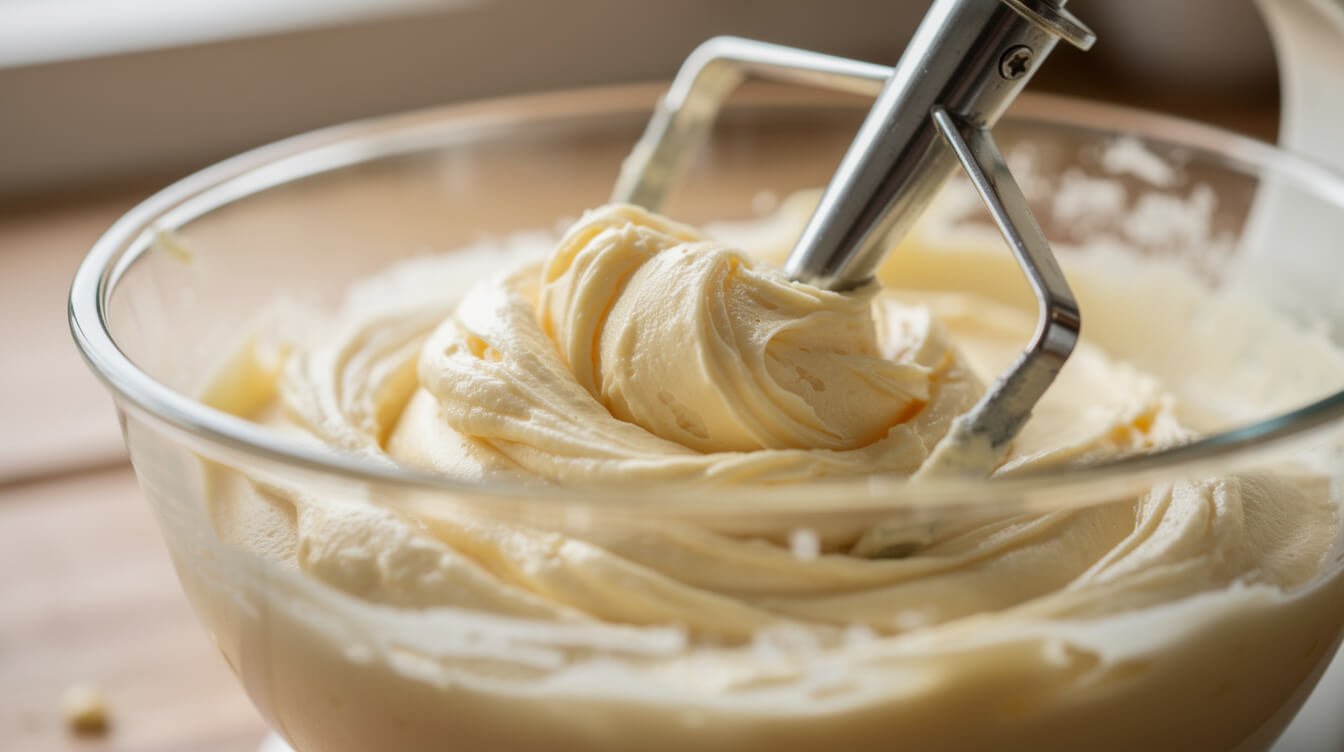
Most cookie doughs are built to be scooped or rolled. Spritz dough has a weirder job: it has to squeeze through a tiny patterned disk, then let go of the press and grab the pan. That asks for a dough that’s soft enough to push, firm enough to keep its ridges, and just tacky enough to stick to bare metal. Here’s what each ingredient is doing.
Butter: soft, not melty
Butter is most of the dough, so its temperature runs the whole show. You want it at room temperature, around 65°F to 68°F, the point where your finger leaves a dent easily but the stick still holds its shape. Too cold and the dough is stiff, the press clicks without anything coming out, and your hand gets tired fast. Too warm, or partly melted in the microwave, and the dough turns greasy. Greasy dough slides on the pan instead of grabbing it, and the shapes blur in the oven.
Unsalted butter lets you control the salt, but salted works fine if that’s what you have. Just cut the added salt in half. There’s more on that in our salted vs. unsalted butter guide.
The egg: binder and glue
One whole egg gives you a dough that’s soft and slightly tacky, which is exactly what helps it stick to the sheet. Some spritz recipes use only a yolk. That makes a richer, sturdier cookie, but the dough is stiffer and harder to push through fine disks. If you try a yolk-only version and the press struggles, add a teaspoon or two of milk.
No leavening, on purpose
There’s no baking powder or baking soda here. Leavening makes cookies puff and spread, and puffing is what erases the ridges you just pressed. Spritz should come out of the oven looking almost exactly like they went in.
Why you don’t chill spritz dough
This is the opposite of what most cookie recipes teach you. Chilled butter dough is too firm for the press. It won’t come out of the disk cleanly, and when it does, it doesn’t stick. Use the dough at room temperature, right after mixing. The pan can be cold, and that helps. The dough should not be. If you make dough ahead and refrigerate it, let it sit out until it’s soft and pliable again before pressing.
Is your favorite cookie recipe press-friendly? A quick ratio check
People ask this every December. A rule of thumb, not a law: a press-friendly dough has about 4 parts butter to 5 parts flour by weight (226g butter to 281g flour here), roughly one egg per batch of that size, little or no leavening, and nothing chunky in it. That means no chocolate chips, nuts, oats, or dried fruit, since they’ll jam the disk.
- Roll-out sugar cookie dough, like our sugar cookies for decorating, usually has more flour and needs chilling. It’s too stiff for most presses.
- Drop cookie doughs with baking soda and mix-ins spread too much and clog the disk.
- Plain butter cookie or shortbread doughs with an egg added are often close. Try a few presses. If it’s stiff, add a teaspoon of milk at a time.
How to make spritz cookies with a cookie press, step by step
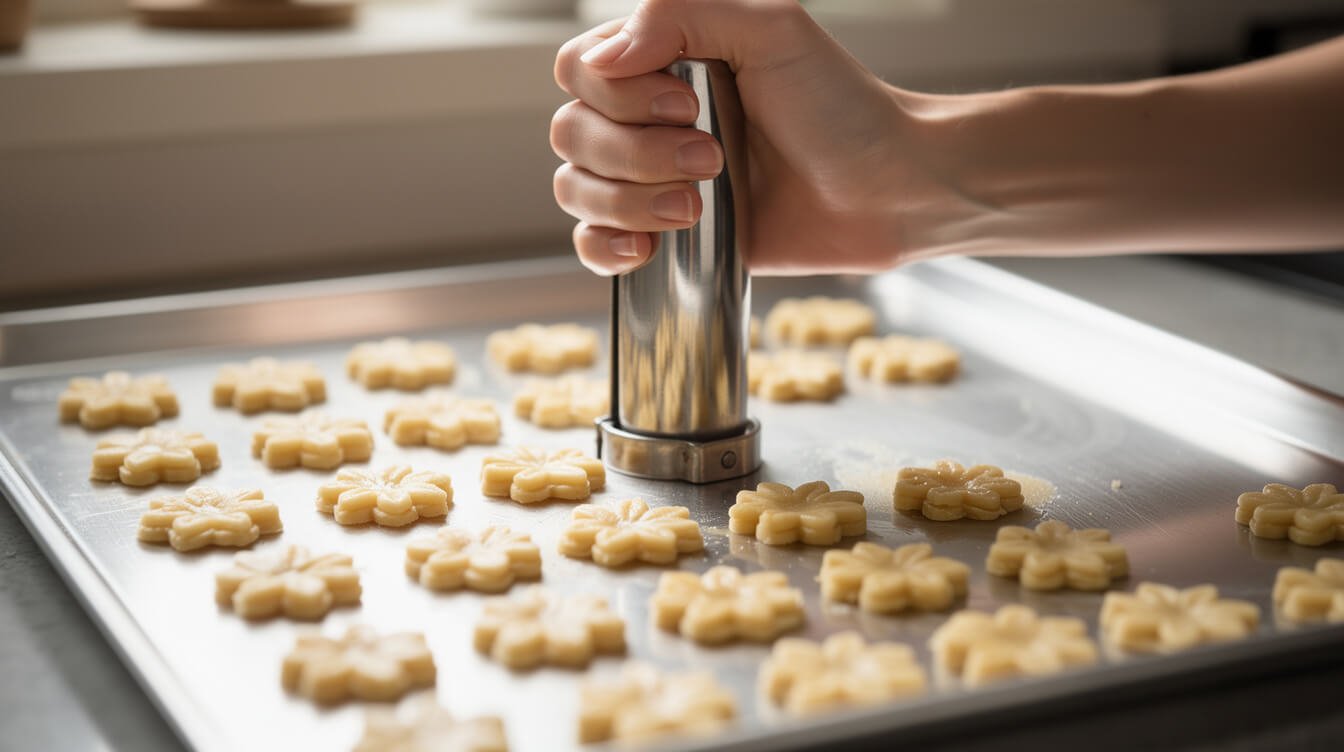
The recipe card covers the basics of cookie press spritz cookies. This is the hands-on part, with the details that make the difference between a frustrating afternoon and a sheet full of neat little wreaths.
1. Set up the sheet: bare, cool, and clean
Spritz work by sticking. When you press, the dough grips the pan just enough that it stays put as you lift the press away. Anything slippery between the dough and the metal breaks that grip:
- Parchment: the dough won’t hold on to it. This is the number one cause of “it keeps lifting off with the press.”
- Grease or cooking spray: same problem, plus the cookies spread.
- Silicone mats: mixed results. Some bakers swear by them, and others can’t get a single cookie to stay. If yours work, great. If not, go bare.
- Bare, light-colored aluminum: the most reliable surface. If you’re choosing a pan, our guide to the best baking sheet explains why light aluminum bakes cookies more evenly than dark nonstick.
Wipe the sheet with a dry paper towel before each batch so there’s no leftover butter film. A cold sheet helps too. Chill it for 10 minutes, or run it under cold water and dry it well between batches.
2. Load the press without air pockets
Roll a portion of dough into a log a bit narrower than the barrel and slide it in, pushing it down so it’s packed with no gaps. Air pockets are why some clicks produce a full cookie and the next one produces a sad half. Put the disk in the right way round. Most have a raised side that faces out, so check your press’s instructions.
3. Hold, click, lift
Hold the press straight up and down with the bottom resting flat on the sheet. Squeeze one full click (some presses need two for larger disks), pause for a beat, then lift straight up. Don’t tilt it or drag it sideways. The dough needs that pause to settle onto the metal.
4. Expect a few throwaways
The first two or three cookies of every fill are often lopsided while the dough settles into the disk. That’s normal, not a sign you’ve done something wrong. Scrape them off with a butter knife and drop them back in the bowl.
5. Decorate before baking
Sprinkles and colored sugar stick best to raw dough. If they’re bouncing off, mist or lightly dab the cookies with water first. Save chocolate dipping for after baking.
Choosing a cookie press
Most modern presses use a trigger or ratchet: one squeeze, one cookie. They’re easier on your hands than old screw-turn styles and more consistent from cookie to cookie. A clear or metal barrel is handy so you can see when you’re running low. You don’t need the one with 20 disks. A tree, a wreath, a flower, and a star cover most holiday trays. If you’re kitting out a kitchen, our 100 Essential Tools guide covers what’s worth buying first and what can wait.
Why your spritz won’t stick or won’t come out (and the fixes)
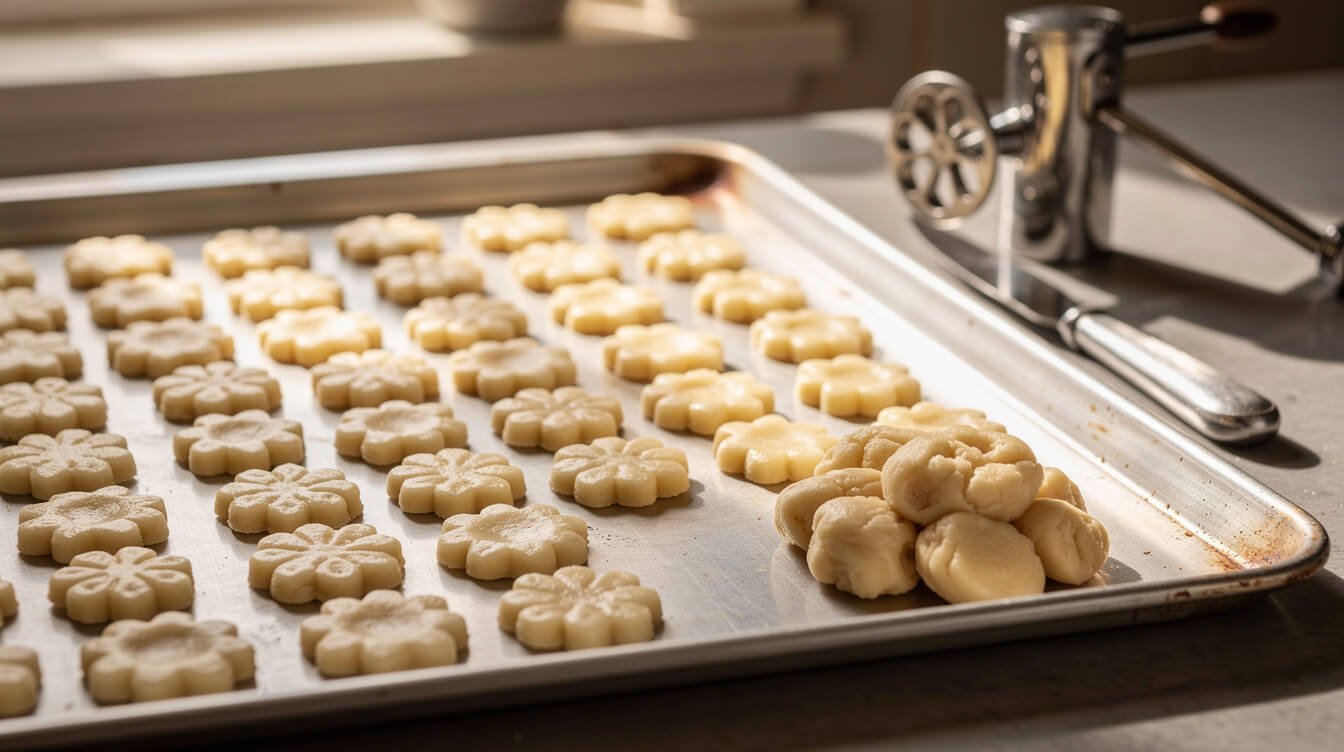
Almost every failure with cookie press spritz cookies comes down to one of three things: the dough temperature, the pan surface, or how the press is held. Find your problem below.
| What’s happening | Usual cause | Fix |
|---|---|---|
| The cookie lifts off with the press | Parchment, grease, a silicone mat that doesn’t grip, a warm pan, or the press lifted too fast | Use a bare, cool, wiped-clean metal sheet. Hold the press flush, pause after the click, lift straight up. |
| The press clicks but nothing comes out | Dough too cold or stiff, air pocket in the barrel, or the plunger isn’t engaged | Let the dough warm up, repack the barrel firmly, and click once or twice to prime it. If it’s still stiff, mix in 1 to 2 teaspoons of milk. |
| Dough oozes out the top or around the disk | Barrel overfilled or disk seated wrong | Fill to just below the top, and check that the disk is flat and the ring is screwed on snugly. |
| Shapes look blurry or spread in the oven | Butter too warm or melted, greased pan, or flour measured light | Chill the pressed cookies, on the sheet, for 10 minutes before baking. Next batch, start with cooler butter, or add 1 to 2 tablespoons of flour. |
| Dough is crumbly and cookies crack at the edges | Too much flour (usually scooped straight from the bag) | Mix in milk 1 teaspoon at a time until smooth. Next time, spoon and level the flour or weigh it. |
| Bottoms brown before the tops set | Dark nonstick pan or an oven running hot | Use a light aluminum sheet, or drop the oven to 350°F and add a minute or two. |
| Cookies stick to the pan after baking | Moved too soon, or left to cool completely on the pan | Wait about 2 minutes, then slide a thin metal spatula under each one. |
The three-second test
Before you fill the press, pinch off a bit of dough and roll it between your fingers. It should feel like soft play dough: smooth, pliable, a little tacky, not greasy. If it cracks, it’s too dry or too cold. If it smears and leaves butter on your fingers, it’s too warm. That little check heads off most of the table above.
When the kitchen is too warm (or too cold)
Room temperature matters more than usual with spritz. In a warm kitchen, with the oven running and a lot of people around, the dough softens fast. Keep half the batch covered and in a cooler spot while you press the other half. In a cold winter kitchen, the dough can stiffen in the barrel. Hold the barrel in your hands for a minute before pressing.
From the Eat Cafe kitchen
One good recipe a week, straight to your inbox
The recipe we're actually cooking this week, plus the one tip that saves it when it goes sideways. No spam. Unsubscribe anytime.
No cookie press? How to pipe spritz instead
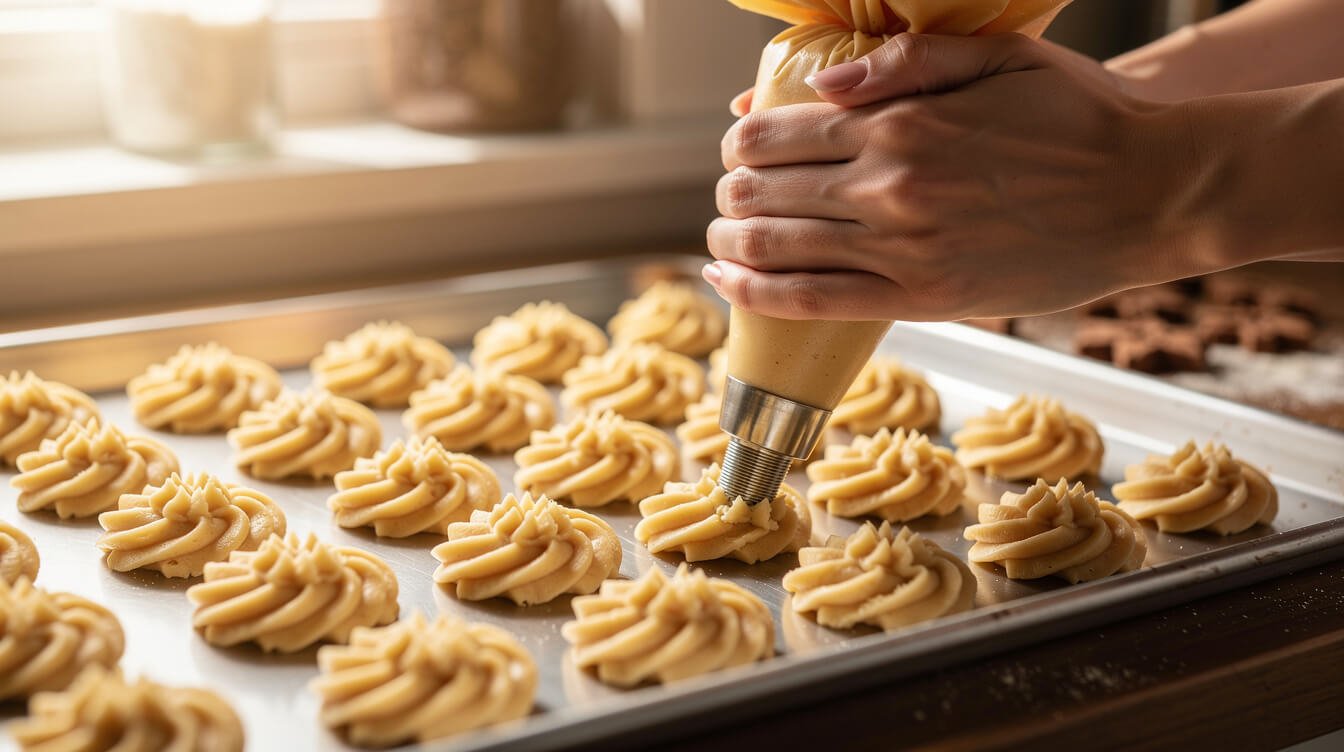
You don’t need a press to make spritz cookies. You just get different shapes. Piped spritz are the swirly rosettes and S shapes you see in tins of Danish-style butter cookies, and they’re lovely.
What changes for piping
- Loosen the dough slightly. Beat in 1 to 2 tablespoons of milk so it’s soft enough to squeeze through a bag. Same recipe otherwise.
- Use a large open star tip (something like a 1M) and a sturdy piping bag. Thin disposable bags can split, because this dough is thicker than frosting. Fill the bag only halfway so you have room to grip.
- Pipe onto a bare sheet, same as with a press. Hold the bag straight above the pan, squeeze a 1 1/2-inch rosette, and stop squeezing before you lift away.
- Chill the piped cookies on the sheet for 10 to 15 minutes before baking. The softer piping dough needs it to keep its ridges.
- Bake a minute or two longer, since piped cookies are usually bigger than pressed ones. Look for barely golden edges.
Other no-press options
If piping isn’t for you, roll the dough into 1-inch balls and press each one with the bottom of a glass dipped in sugar, or with a fork in a crisscross. You’ll get the same buttery spritz flavor in a simple round cookie. If the dough is too soft to roll, chill it for 20 minutes first. Chilling is fine when you’re not using a press.

100 Essential Tools Every Chef Has in Their Kitchen
Cookie press, piping bags, a light aluminum sheet: holiday baking is when you find out which tools you’re missing. This eBook and guide walks through what’s worth owning, what to buy first, and what can wait.
Decorating, storing, and freezing spritz cookies
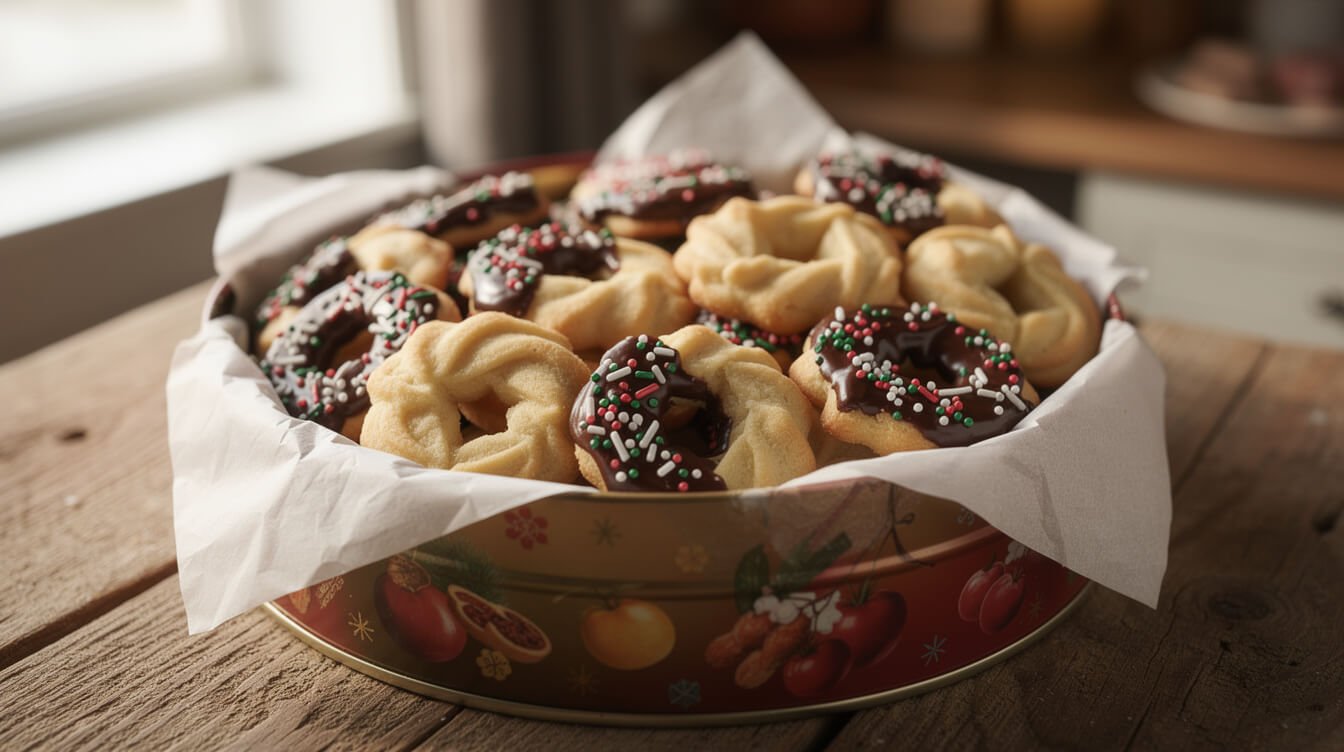
Cookie press spritz cookies are one of the best make-ahead holiday cookies there is. They’re small, sturdy, and they keep well, which makes them ideal for cookie trays, swaps, and mailing.
Easy ways to decorate
- Tinted dough: gel color gives bright shades without making the dough wetter. Liquid food coloring can make it soft. Green trees and pale pink flowers are the classics.
- Sprinkles or sanding sugar, pressed on before baking.
- Chocolate dip: once the cookies are completely cool, dip half of each in melted chocolate. Add sprinkles while it’s wet, then let it set on parchment. Parchment is perfect here, because nothing needs to stick.
- Sandwich them: join two flat shapes with a thin layer of jam, chocolate, or buttercream.
- A drizzle of icing: a thin powdered sugar glaze works, or use our meringue powder royal icing if you want it to dry hard for stacking.
Flavor swaps are easy too. Replace the almond extract with lemon zest, orange zest, peppermint extract (start with 1/4 teaspoon, since it’s strong), or a pinch of cinnamon and nutmeg.
Storing baked spritz
Once they’re fully cool, keep them in an airtight tin or container at room temperature for about a week. Keep spritz away from soft cookies, or they’ll pick up moisture and lose their snap. If they do soften, a few minutes in a 300°F oven and a full cool-down usually crisps them back up. Chocolate-dipped cookies keep best in a single layer, or layered between sheets of parchment.
Making the dough ahead
- Fridge: wrap the dough well and refrigerate for up to 3 days. Let it come all the way back to soft room temperature before pressing. Don’t rush it in the microwave, which melts the edges.
- Freezer: wrap the dough tightly in plastic, then put it in a freezer bag, for up to 2 months. Thaw overnight in the fridge, then soften on the counter.
Freezing baked spritz
Freeze undecorated or sprinkle-topped cookies in a sturdy container, layered with parchment, for up to 3 months. Thaw them at room temperature with the lid on, so condensation forms on the container instead of the cookies. Dip them in chocolate after thawing, not before.
Planning a whole tray? Spritz fit right into the make-ahead schedule in our easy Christmas cookies ideas. They sit next to jam thumbprints and gingerbread molasses cookies beautifully.
Cookie press spritz cookies FAQ
Can spritz cookies be made without a press?
Yes. Loosen the dough with 1 to 2 tablespoons of milk and pipe it through a large open star tip, then chill the piped cookies for 10 to 15 minutes before baking. See the piping section above.
Can I use parchment paper for spritz cookies?
Not for pressing. The dough won’t stick to parchment, so it lifts off with the press. Press onto a bare metal sheet. Parchment is great later, for setting chocolate-dipped cookies.
Do I need to chill spritz dough?
No, and you shouldn’t before pressing. Cold dough is too stiff for the press and won’t stick to the pan. Chill the sheet, not the dough. If the pressed cookies look soft or droopy, chill them on the sheet for 10 minutes before baking.
Can I use any cookie recipe in a cookie press?
Not most of them. Press dough needs to be soft, smooth, low on leavening, and free of chunks. A good check: about 4 parts butter to 5 parts flour by weight, one egg, and no chips or nuts. Stiff roll-out doughs and chunky drop-cookie doughs won’t work well.
Do I need a special baking sheet?
No. Any flat, light-colored metal sheet works, rimmed or rimless. The press just has to sit flat, so on a rimmed half-sheet, start a couple of inches in from the edges so the press doesn’t bump the rim and tilt.
Should I use a stand mixer or a hand mixer?
Either works. It’s a small, soft dough. A hand mixer is plenty. If you bake a lot of holiday batches, a stand mixer saves your arm. Our best stand mixer for home cooks guide covers whether it’s worth it.
How long do spritz cookies last?
Baked cookie press spritz cookies keep about a week at room temperature in an airtight container, and up to 3 months in the freezer.
Can I taste the dough?
Please don’t. It contains raw flour and raw egg, which aren’t safe to eat uncooked. Bake a test cookie instead. It only takes 8 minutes.
Why did my spritz come out hard?
Usually too much flour, or overbaking. Spoon and level the flour (or weigh it, 281g), and pull the cookies when the edges are just barely golden. They firm up as they cool.
The short version
- Use soft, room-temperature butter: dentable, not greasy.
- Don’t chill the dough. Do chill the sheet.
- Press onto a bare, ungreased, unlined metal sheet. No parchment.
- Hold the press flush, one full click, pause, lift straight up.
- The first few cookies of each fill are throwaways. That’s normal.
- Stiff dough or nothing comes out: warm it, or add a teaspoon of milk. Blurry shapes: chill the pressed cookies 10 minutes.
- Bake at 375°F for 7 to 9 minutes, until the edges are just golden.
- Store airtight for about a week, or freeze for up to 3 months.
That’s it. Once the dough and the pan are right, cookie press spritz cookies are one of the fastest holiday cookies you can make: dozens of little wreaths and trees in under an hour. Make a batch this weekend, and keep the extras in the freezer for whenever someone stops by.

Before you go
Want the next one?
We post a new recipe or kitchen guide every day. The best of the week lands in one short email, no life story attached.