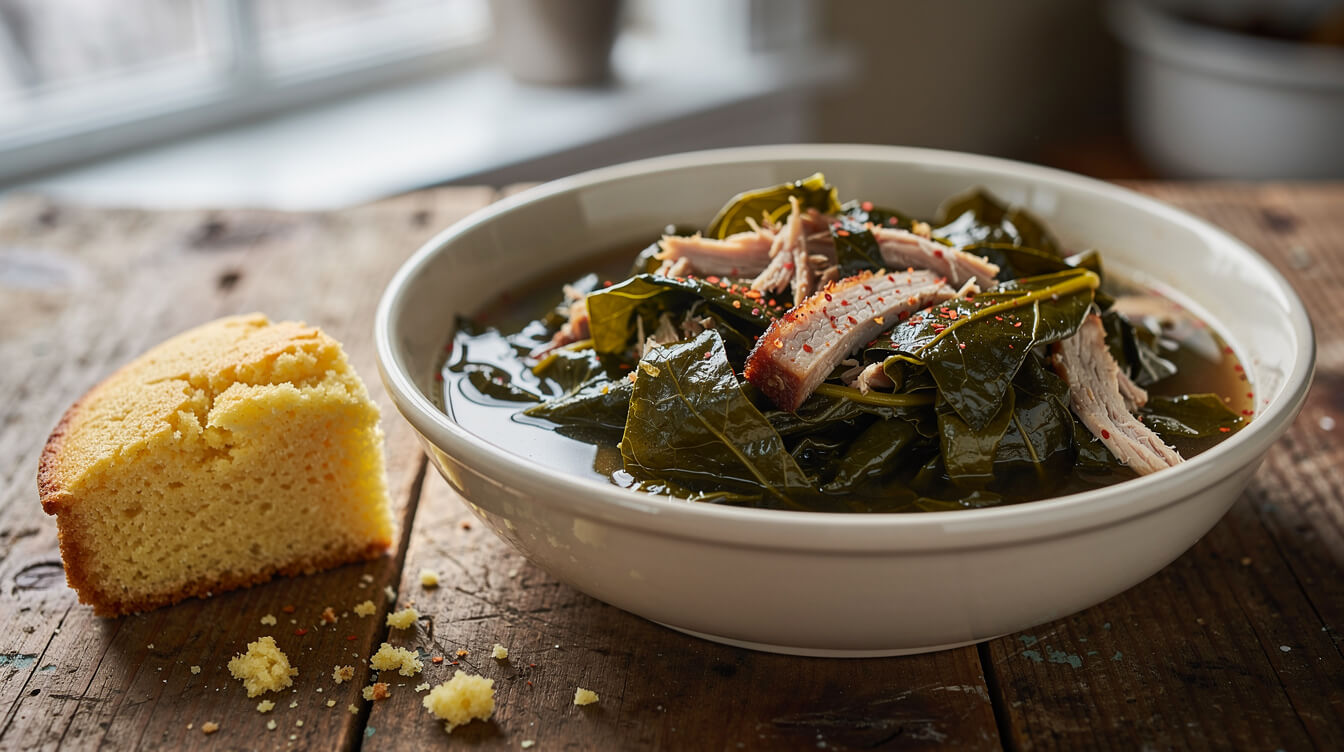
Seasoned collard greens: Southern-style greens that are tender, not bitter (from scratch or doctored from a can)
Seasoned collard greens should be silky, smoky, a little tangy, and so good that people fight over the broth at the bottom of the pot. But a lot of pots come out bitter, tough, gritty, or so salty you can’t eat more than a forkful. The fix isn’t a secret ingredient. It’s balance, plus three habits: get the stems out, simmer low and long, and add the salt and vinegar at the end instead of the beginning.
The recipe is right below. First comes the simple five-part seasoning formula that makes greens taste “seasoned” instead of just salty. Then there are four smoky options (smoked turkey, ham hock, bacon, or meatless) and how each one changes your timing. Prep is next, so you never bite into grit again. There’s also a 15-minute way to make canned or frozen collards taste homemade on a busy night, plus what to serve them with, from Thanksgiving to the New Year’s Day table, and how to store and freeze the leftovers.
Seasoned collard greens: the five-part flavor balance
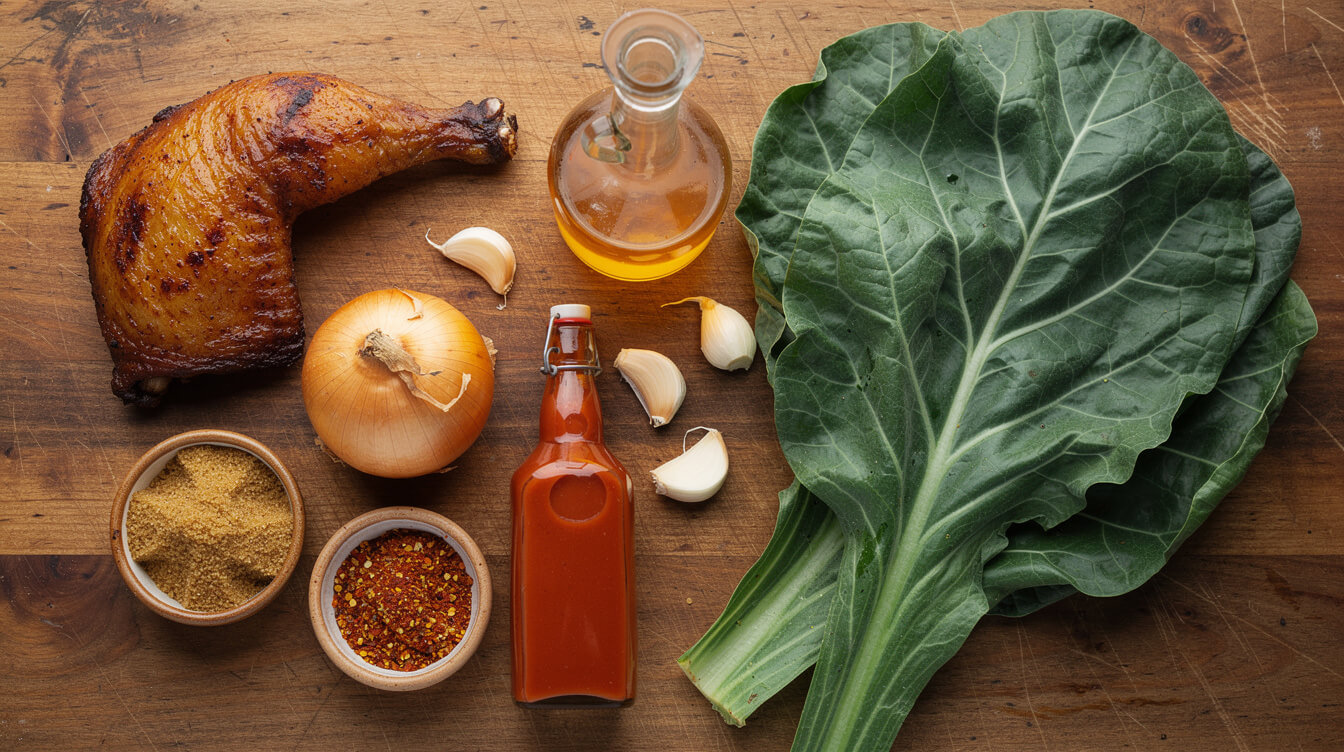
Most recipes hand you a list of ingredients and leave it there. What actually makes a pot of seasoned collard greens taste right is that five things are in balance. When greens taste flat or bitter, one of these is almost always missing or out of proportion.
- Smoke. This is the backbone. It usually comes from a smoked turkey wing or leg, a ham hock, or bacon. For meatless greens, smoked paprika does the job. Smoke turns plain cooked greens into Southern greens.
- Fat. Fat carries the flavor and softens the greens’ natural bite. Most of it comes from the smoked meat. If you go meatless or use lean smoked turkey, add a couple tablespoons of butter, olive oil, or bacon drippings.
- Acid. A splash of apple cider vinegar at the end wakes everything up and cuts through the richness. This is the part people skip, and it’s the reason their greens taste heavy.
- A little sweet. Just a teaspoon or two of brown sugar. You shouldn’t be able to taste it as sugar. It just rounds off the bitter edge of the leaves and the sharpness of the vinegar.
- Heat. Crushed red pepper flakes in the pot, hot sauce at the table. Enough to warm, not to burn.
Then there’s salt, which isn’t really a “part” so much as the finishing touch. Smoked meats are cured, and cured meat is salty. Broth is salty too. And the broth cooks down for an hour or more, which concentrates everything. If you salt at the start the way you would a soup, you can easily end up with a pot that’s too salty to save. So salt goes in last, after you’ve tasted.
The formula, in amounts
For one pot made with two big bunches of collards (6 to 8 servings), this is the balance to start from:
- Smoke: 1 1/2 to 2 pounds smoked turkey, or 1 large ham hock, or 6 slices thick-cut bacon, or 2 teaspoons smoked paprika
- Fat: whatever the meat gives you, plus 2 tablespoons butter or oil if it’s lean or meatless
- Acid: 2 tablespoons apple cider vinegar, stirred in at the end, then more to taste
- Sweet: 2 teaspoons brown sugar (up to 1 tablespoon if your greens are big and bitter)
- Heat: 1/2 teaspoon crushed red pepper flakes, plus hot sauce for serving
- Salt: at the end, a pinch at a time
Memorize that, and you can season any pot of greens, from scratch or from a can, without a recipe.
Ingredients and your smoky meat options
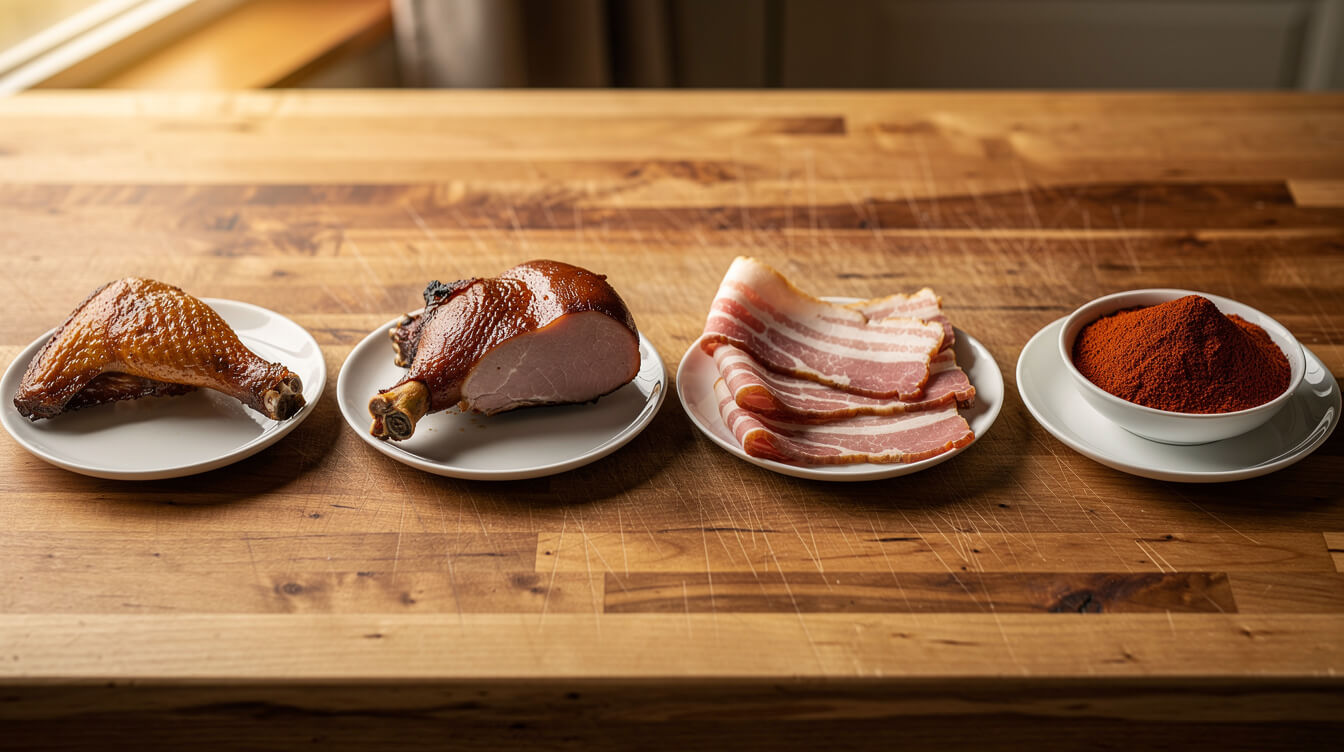
Here’s everything for a from-scratch pot of seasoned collard greens. Serves 6 to 8 as a side.
Ingredients
- 2 large bunches collard greens, about 3 to 4 pounds before trimming (or two 1-pound bags of pre-cut collards)
- 1 1/2 to 2 pounds smoked turkey wings, legs, or necks (or one of the other smoky options below)
- 1 tablespoon oil or bacon drippings
- 1 large yellow onion, diced
- 4 cloves garlic, minced
- 1/2 teaspoon crushed red pepper flakes
- 6 cups low-sodium chicken broth, plus about 2 cups water
- 2 teaspoons brown sugar
- 2 to 3 tablespoons apple cider vinegar
- Salt and black pepper, to taste, at the end
- Hot sauce, for serving
Low-sodium broth matters more here than almost anywhere else. The smoked meat brings plenty of salt, and the broth will reduce. Starting low gives you room to season at the end.
Choosing your smoke: four options and how they change the cook
Smoked turkey (wings, legs, or necks). This is the most common choice today. It gives a deep, clean smokiness, a decent amount of meat to shred back into the pot, and less grease than pork. Turkey wings and legs are tough, so give them about an hour in the broth before the greens go in. Look for them near the ham and sausage at the grocery store, especially around the holidays.
Smoked ham hock. This is the old-school, porky, rich option. Hocks have lots of skin, bone, and collagen, which gives you a silkier pot likker but not much meat. They need the longest head start, about 1 to 1 1/2 hours of simmering before you add the greens. A leftover holiday ham bone works the same way.
Bacon. This is the fastest option. Chop 6 slices of thick-cut bacon, cook it in the pot until crisp, and leave the drippings in for cooking the onion. There’s no head start needed, so your greens can go in after a 10-minute simmer of the broth. You get less depth than with a long-simmered hock, but it’s great on a weeknight.
Meatless. Use vegetable broth, 2 tablespoons butter or olive oil, and 2 teaspoons smoked paprika added with the garlic. A few drops of liquid smoke are optional. A spoonful of miso or a splash of soy sauce adds some of the savory depth meat would bring (go easy on the salt if you do). There’s no head start here either.
Prepping collards: stems out, grit out, cut into ribbons
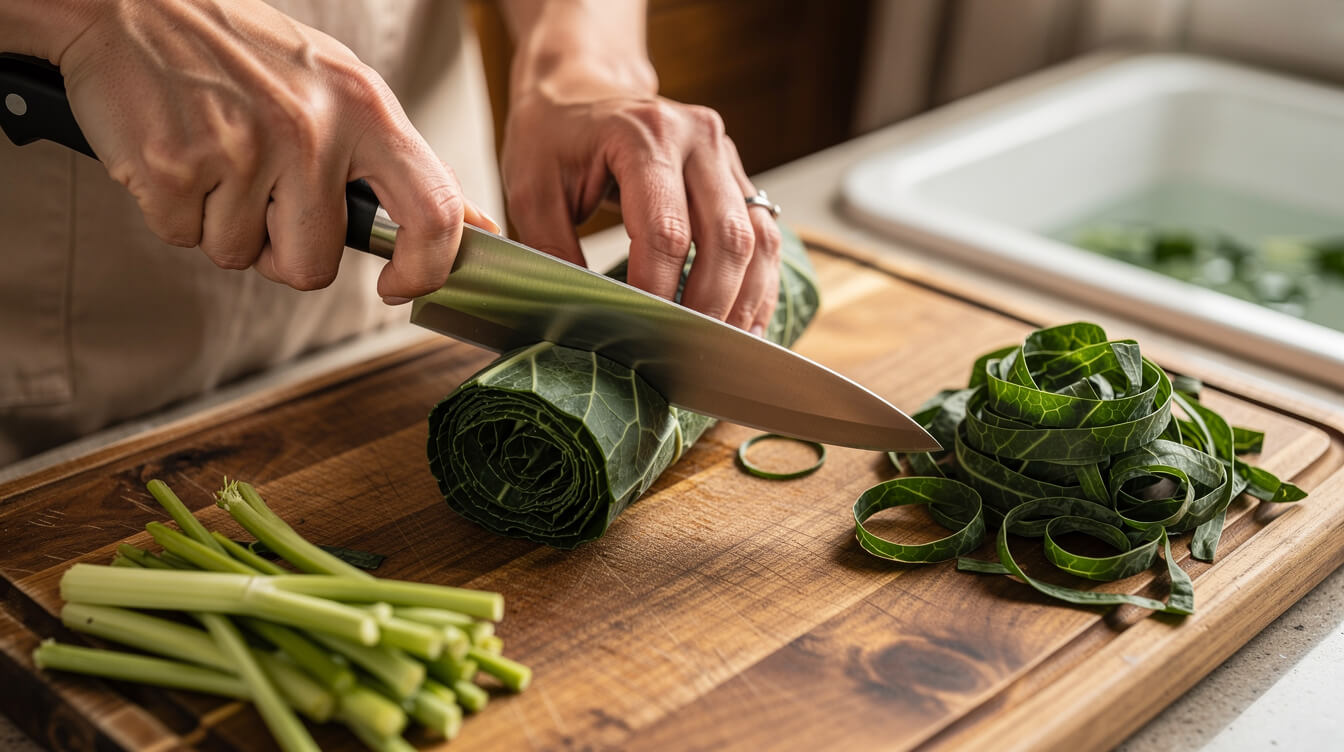
Prep is where most bitter, tough, or gritty pots of greens go wrong. It takes about 20 minutes for two bunches. Put on some music.
1. Pull the stems
The thick center stem is fibrous, and it stays tough long after the leaves are tender. Hold a leaf by the stem end and pull the leaf away from the stem with your other hand, like unzipping it. Or fold the leaf in half along the stem and slice the stem out with a knife. Thin stems near the tip of the leaf are fine to leave.
If you hate to waste them, slice the stems very thin and add them to the pot 20 minutes before the leaves. They’ll soften, though they never get as silky as the leaves.
2. Wash out the grit (more than once)
Collards grow low to the ground, and sand hides in every curl. One rinse isn’t enough. Fill a clean sink or a big bowl with cool water, add the leaves, and swish them around hard. Let them sit for a few minutes so the grit sinks. Then lift the leaves out, leaving the water behind. If you pour the water and greens out together, the grit goes right back onto the leaves.
Drain, rinse the sink, and do it again. Keep going until there’s no sand at the bottom. Usually that takes two or three rounds. Some cooks add vinegar or salt to the soak. It’s fine if you like it, but plain water and patience do the job.
Bagged pre-cut collards are a big time-saver, and they’re already washed. Still give them a quick rinse, and pick out any thick stem pieces, because bags are full of them.
3. Cut into ribbons
Stack 6 or 8 stemmed leaves, roll them up tightly like a cigar, and slice across the roll into ribbons about 1/2 to 1 inch wide. This is quick and tidy, and the greens cook evenly. A sharp chef’s knife makes it go much faster. If yours is struggling, our guide to the best kitchen knife brands for home cooks covers good ones at every budget. Tearing the leaves by hand works too, if you like a more rustic pot.
Don’t panic at the size of the pile. Two bunches of raw collards fill a sink, and they cook down to about a quarter of that.
How to make seasoned collard greens from scratch
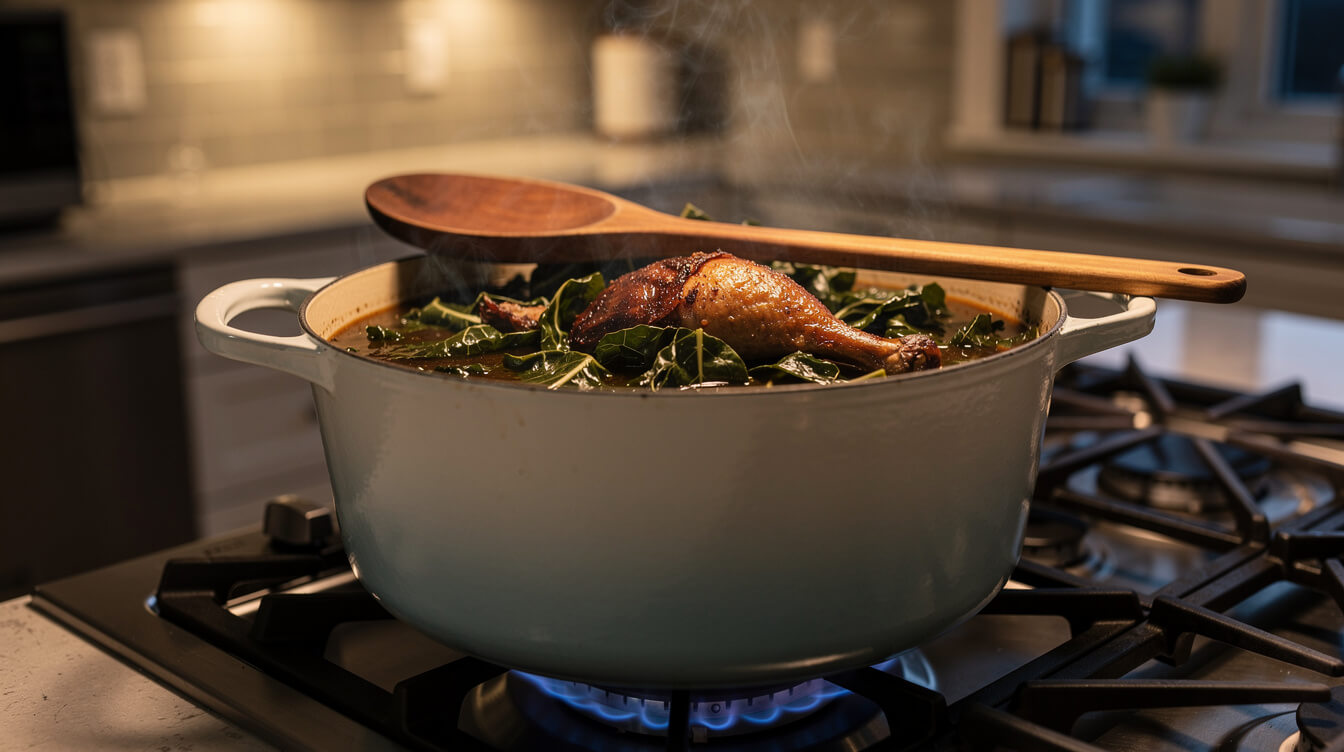
A big Dutch oven or a heavy 6- to 8-quart pot is ideal. A heavy pot holds a steady, gentle simmer without scorching the bottom. If you’re shopping for one, here’s our honest take on the best Dutch oven for home cooks.
Step 1: Build the pot likker (about 1 hour)
Heat the oil in the pot over medium heat. Add the onion and cook until soft and translucent, about 5 minutes. Stir in the garlic and red pepper flakes for 30 seconds, until fragrant.
Add the smoked turkey, the 6 cups of broth, and about 2 cups of water, enough to mostly cover the meat. Bring it to a boil, then turn it down to a gentle simmer, cover, and cook for about 1 hour. (For a ham hock, 1 to 1 1/2 hours. For bacon or meatless, just 10 minutes.)
This is the step that makes the difference. You’re making a smoky, savory broth before the greens ever touch it. That broth is the pot likker, and it’s what seasons every leaf.
Step 2: Add the greens and simmer low (45 minutes to 1 1/2 hours)
Add the greens by big handfuls, stirring each batch down into the broth as it wilts before adding the next. When they’re all in, the liquid should come up to just about cover them. Add a splash more water if it doesn’t. Stir in the brown sugar.
Bring back to a simmer, then lower the heat until it’s barely bubbling. Partially cover and cook, stirring every 15 minutes or so. Start tasting at 45 minutes. Young, tender collards may be done in under an hour. Big, thick winter leaves can take 1 1/2 hours or more. They’re done when a ribbon is silky and tender all the way through, with no chew left. A hard boil won’t speed this up. It just makes the greens tough and the broth cloudy.
Step 3: Pick the meat
Fish out the turkey (or hock), set it on a plate until it’s cool enough to handle, and pull the meat off the bones. Discard the skin, bones, and gristle, and stir the meat back into the greens.
Step 4: Season at the end
This is where seasoned collard greens become yours. Stir in 2 tablespoons of the vinegar. Taste the pot likker, not just a leaf. Then adjust, in this order:
- Tastes flat or heavy? More vinegar, a teaspoon at a time.
- Still a little bitter or sharp? A pinch more brown sugar.
- Not savory enough? Now, and only now, add salt, a pinch at a time. Taste between pinches.
- Want more warmth? Black pepper in the pot, and pass the hot sauce at the table.
Serve hot with a slotted spoon, and spoon a little pot likker over each serving. Keep the rest. It’s the best part, and you’ll want it for cornbread.
From the Eat Cafe kitchen
One good recipe a week, straight to your inbox
The recipe we're actually cooking this week, plus the one tip that saves it when it goes sideways. No spam. Unsubscribe anytime.
Short on time: canned or frozen collards that taste homemade
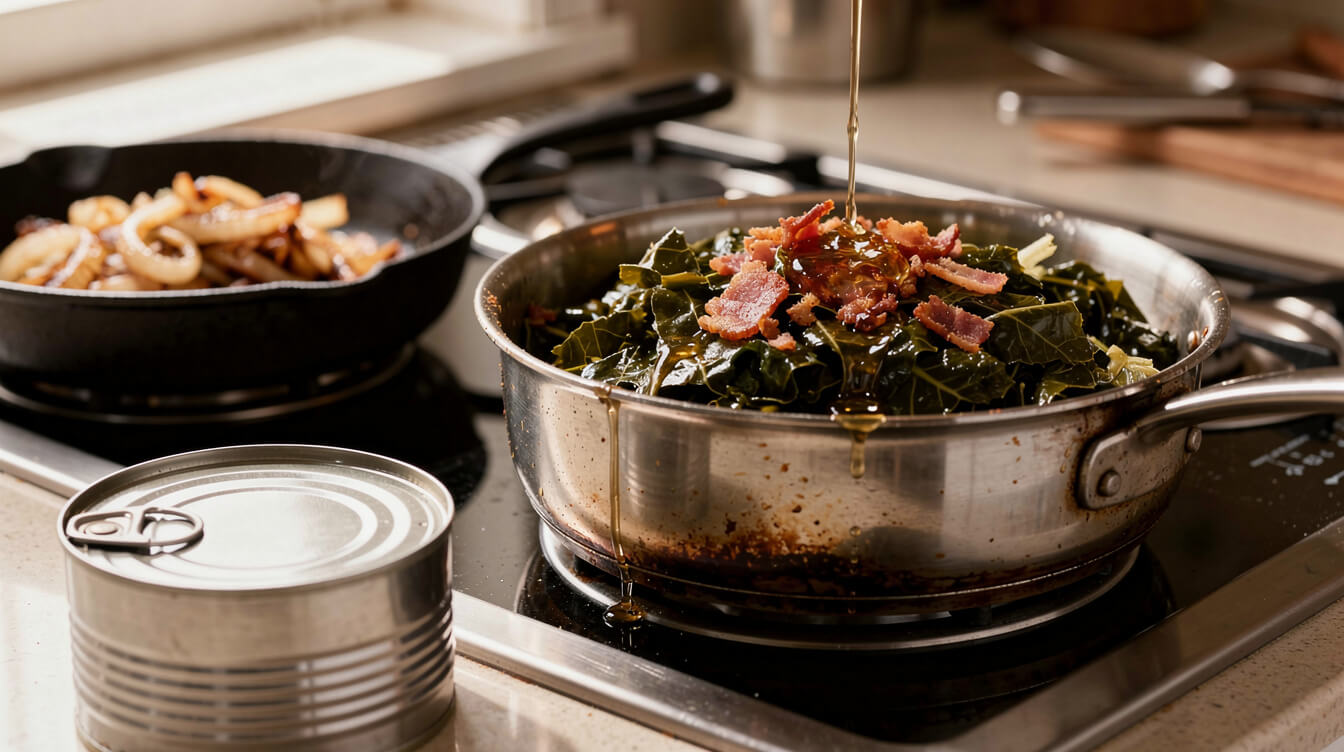
Plenty of people buy seasoned collard greens in a can or a freezer bag, and there’s nothing wrong with that. Nobody’s grading you. Here’s how to make them taste like they simmered all afternoon, in about 15 minutes.
Doctoring canned collards (15 minutes)
Canned collards are already fully cooked, so all you’re doing is adding the flavor layers the can doesn’t have. For about 2 pounds of canned greens (two large cans, or three or four regular ones):
- Cook 2 or 3 slices of chopped bacon in a saucepan until crisp. (Meatless: 2 tablespoons butter plus 1 teaspoon smoked paprika.)
- Add half a diced onion and cook until soft, about 5 minutes. Add 2 cloves of minced garlic and a pinch of red pepper flakes for 30 seconds.
- Add the greens with about half of their liquid. Pour off the rest of the can liquid, since it’s usually salty and tastes like the can. Add 1/2 cup of low-sodium chicken broth.
- Simmer uncovered for 10 minutes so the flavors move into the greens.
- Finish with 1 tablespoon cider vinegar and a small pinch of brown sugar. Taste before you even think about salt.
That last part matters. “Seasoned” canned greens are usually already salted, and many have pork seasoning in them. Most of the time they need zero added salt. The vinegar is what makes them taste fresh instead of canned.
Cooking frozen collards
Frozen chopped collards are blanched, not fully cooked, so they need more time than canned. They’re also already washed and stemmed, which saves the 20 minutes of prep. Build a quick pot likker with bacon or a smoked turkey wing simmered in broth for as long as you have (even 20 minutes helps). Then add the greens straight from the freezer, no thawing. Simmer for about 30 minutes, until tender, and season at the end just like the from-scratch pot. Frozen greens can go mushy if they cook too long, so start checking at 25 minutes.
Either shortcut makes a solid side for a busy night. Pair it with a rotisserie chicken or one of our easy weeknight dinners for family, and dinner’s done.
And if you’re carrying a pot of greens to a church supper, a community dinner, or a charity potluck this season, our Support Our Charities T-shirt is a comfortable one to wear while you serve.

A shirt for potluck season
The Eat Cafe Support Our Charities tee is a comfortable, sturdy black cotton shirt with a small logo over the heart and a big one on the back. It’s an easy one to wear behind a potluck table or a community dinner line, ladling out greens and passing the cornbread.
What to serve with collard greens
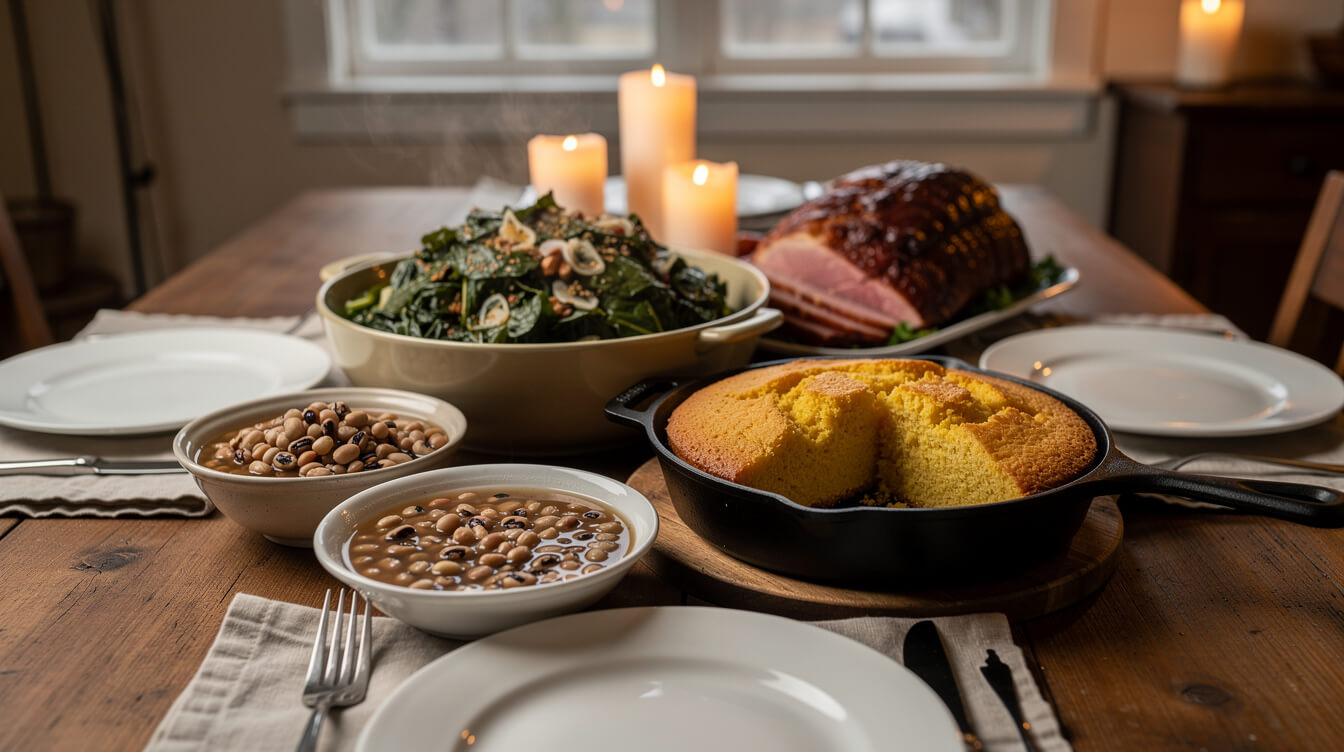
Seasoned collard greens go with nearly anything rich, smoky, or fried. They also fit right in at holiday dinners.
Cornbread, always
If there’s one rule, it’s this: serve cornbread for sopping up the pot likker. Our recipe for cornbread using buttermilk is the one we make for greens. It’s moist, golden, and sturdy enough to drag through the bottom of the bowl.
Thanksgiving and Christmas
Collards are a natural on the holiday table next to turkey or ham, mac and cheese, candied yams, and dressing. They’re also one of the best make-ahead sides there is (more on that below), which frees up the stove on the big day. For more ideas for the whole spread, see our Thanksgiving dinner ideas. And if you’re staring at a fridge full of leftovers tomorrow, our turkey leftover recipes have a plan for using it all up.
New Year’s Day: greens, peas, and cornbread
In the South, a lot of families eat greens on New Year’s Day for luck in the year ahead. The greens stand for money (folded bills), black-eyed peas or Hoppin’ John stand for coins and good luck, and cornbread stands for gold. Make a pot on December 31, and it’ll taste even better on the first.
Sunday dinner and everyday plates
Fried chicken, smothered pork chops, baked or fried catfish, pot roast, barbecue, meatloaf, and beans and rice all go with collards. For a full spread, our soul food Sunday dinner ideas put collards right where they belong, in the middle of the table.
A note on where this dish comes from: the collard plant is an old relative of cabbage, but the way most Americans cook it comes out of African American cooking in the South. That means low and slow with smoked meat, with the pot likker saved and sopped up. Southern home cooks have carried it forward for generations. It’s a dish worth making the way it was meant to be made, with time and care.
Storing, freezing, and reheating collard greens
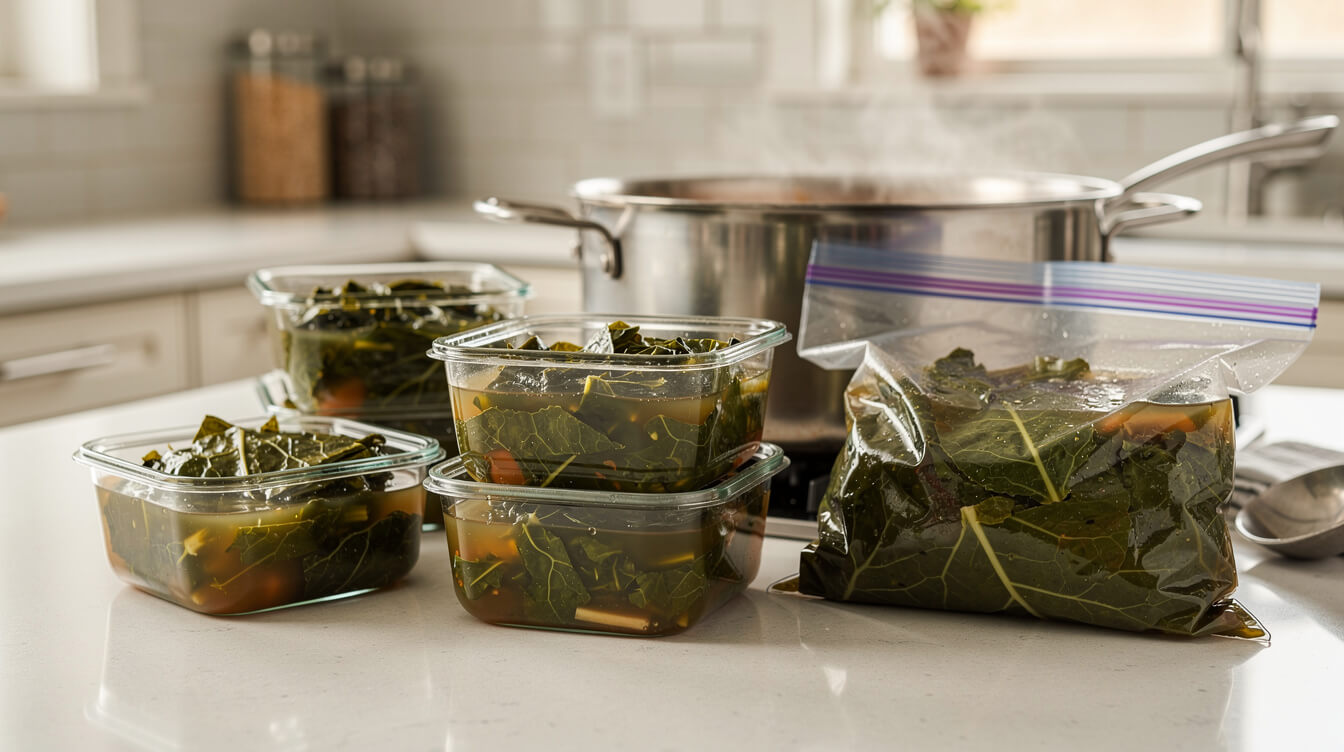
Seasoned collard greens are one of those dishes that taste better the next day. The greens keep soaking up the pot likker. That makes them a great make-ahead side.
- Cooling: Get leftovers into the fridge within 2 hours of cooking. A big pot of greens holds heat for a long time, so divide it into shallow containers so it cools quickly.
- In the fridge: Keep them in an airtight container, with their pot likker, and eat them within 3 to 4 days.
- In the freezer: Freeze in airtight containers or flat freezer bags, with enough pot likker to cover. They keep their best quality for about 3 months. Leave a little headspace, since liquid expands as it freezes.
- Thawing: Thaw overnight in the fridge, or reheat straight from frozen in a covered saucepan over low heat.
- Reheating: Warm them in a saucepan with a splash of broth or water until they’re steaming and the likker is simmering all the way through. A microwave works too. Cover the dish and stir partway so they heat evenly.
Taste after reheating. A fresh splash of vinegar brings day-two greens right back to life.
Making them ahead for a holiday: Cook them completely up to 2 days before, cool, and refrigerate. Reheat on the stove while the main dish rests. That’s one less pot to watch on the big day.
Seasoned collard greens FAQ
How do you make collard greens less bitter?
Pull out the thick stems, and cook the greens low and slow until fully tender. Undercooked collards taste the most bitter. Then balance the pot: enough smoky fat, a splash of vinegar at the end, and a teaspoon or two of brown sugar. Young, smaller leaves are usually milder than very large, thick ones. Many Southern cooks also swear that collards picked after the first frost taste sweeter, which is part of why they’re a winter dish.
What’s the best seasoning for collard greens?
There isn’t one single seasoning. It’s the balance. Use something smoky (smoked turkey, ham hock, bacon, or smoked paprika), plus onion and garlic, a splash of apple cider vinegar, a little brown sugar, red pepper flakes, and salt at the very end. Some cooks add a dash of seasoned salt, onion powder, or a spoonful of bouillon. Just account for the salt in those before you add more.
How long do you cook collard greens?
Plan on 45 minutes to 1 1/2 hours of gentle simmering once the greens go in. That’s on top of about an hour to build the pot likker if you’re using smoked turkey or a ham hock. Start tasting at 45 minutes, and cook until they’re silky with no chew.
What is pot likker?
Pot likker (also spelled pot liquor) is the smoky, savory broth left in the pot after the greens simmer. It’s a cherished part of the dish. Spoon it over each serving, sop it up with cornbread, or sip it from a cup. Don’t pour it down the drain.
Can you make collard greens in a slow cooker?
Yes. Cook the onion and garlic in a skillet first for better flavor, then add them to the slow cooker with the smoked meat, the broth (use a little less, about 4 cups, since a slow cooker loses less to evaporation), the brown sugar, and the prepped greens. Cook on low for 6 to 8 hours or on high for about 4, until tender. Pull and shred the meat, then add the vinegar and salt at the end. Our slow cooker beef stew is a good main to run alongside it on a Sunday.
Can you make them in an Instant Pot?
Yes, and it’s the fastest from-scratch route. Saute the onion and garlic, add the smoked turkey and about 3 cups of broth, and pressure-cook on high for 20 minutes to give the meat a head start. Quick-release, add the greens (pack them in below the max fill line), and pressure-cook on high for another 15 to 20 minutes. Then let it release naturally for 10 minutes. Shred the meat, then season with vinegar and salt at the end.
Can you use other greens?
Yes. Turnip greens and mustard greens cook the same way but faster, usually 30 to 45 minutes, and they’re a bit more peppery. A mix of collards and mustard or turnip greens is classic. Kale works too in about 30 minutes. If you love greens, our guide to leafy greens to grab at the farmstand has more to try.
The short version
Seasoned collard greens come down to a few habits. Pull the stems and wash out every bit of grit. Simmer the smoked meat in low-sodium broth first to build the pot likker. Then cook the greens low and slow until they’re silky. Balance smoke, fat, a little sweet, and heat as you go, and save the vinegar and salt for the end, after you taste. Short on time? Doctor a can with bacon, onion, broth, and a splash of vinegar, and skip the salt. However you make them, serve cornbread for the pot likker.

Before you go
Want the next one?
We post a new recipe or kitchen guide every day. The best of the week lands in one short email, no life story attached.